
TL;DR
Nutrition experts say dates provide fiber, antioxidant compounds and minerals, and can be a sweet alternative to other treats. They are also calorie-dense and high in natural sugar; reported benefits do not mean dates alone prevent or treat disease.
A Good Housekeeping report has outlined seven potential health benefits of dates, drawing on comments from nutrition experts about their fiber, antioxidant compounds and minerals. The report presents dates as a nutrient-rich, naturally sweet fruit, while noting they also contain substantial sugar and calories and that some proposed benefits are not established by the nutrition figures alone.

Get baking supplies delivered free with Prime
- Fast, free delivery on millions of items
- Prime Video, Amazon Music and more included
- Member-only deals all year
Four pitted Medjool dates provide about 266 calories, 72 grams of carbohydrates, 64 grams of total sugar and 6.4 grams of fiber, according to the nutrition figures in the report. They also contain potassium, magnesium, phosphorus and calcium. Values are for Medjool dates specifically; other varieties and serving sizes may differ.
The seven benefits described are that dates are nutrient-dense, may fit the broad definition of a superfood, contain antioxidants, provide fiber, may support heart health, supply minerals relevant to bones and can be used in many foods. These points are not all equivalent: the nutrient and fiber amounts are reported as composition, while claims about disease risk or health effects need to be understood as potential associations rather than guarantees.
Michael Crupain, a physician and public health faculty member quoted in the article, says two dates provide about 3 grams of fiber, which he describes as a little over 10% of the daily recommended amount. The report also cites Dawn Jackson Blatner, a registered dietitian, who recommends two or three Medjool dates as a serving. She notes that dates contain pits, which should be removed before eating unless the fruit is already pitted.
Dates’ Nutrients and Trade-Offs
The report gives readers a way to weigh dates as a snack or ingredient: they offer fiber and micronutrients, but their natural sweetness comes with a concentrated amount of sugar and calories. That distinction matters for people choosing foods to fit their overall diet, including anyone tracking carbohydrate or calorie intake. The supplied source does not offer individualized dietary advice.
It also tempers broad health language. Fiber is linked with digestive function and has been associated with health outcomes, while dates’ antioxidant compounds and minerals are reasons for interest. But a food’s nutrient profile does not show that eating it on its own prevents heart disease, diabetes, cancer or bone conditions. The report characterizes some benefits as potential and cites preliminary research, not proof of treatment or prevention.
Products Worth Considering

Traeger Tailgater 20 Portable Wood Pellet Grill and Smoker, 300 sq. in.

Traeger Pro 22 Wood Pellet Grill and Smoker, 572 sq. in.

Ninja PossibleCooker PRO Plus 11-in-1, 8.5-Quart, Trace Blue (MC2002BL)
As an affiliate, we earn on qualifying purchases.
What the Nutrition Figures Show
The article focuses its nutrition panel on Medjool dates, a popular variety in the United States. Its figures are for four pitted fruits, whereas the dietitian’s suggested serving is two or three. Readers should keep those serving bases separate when comparing the sugar, calorie and fiber totals.
The report says dates contain phenolic antioxidants, including catechins, and flavonoids. It describes these compounds as having antioxidant properties and notes that research has associated date polyphenols with a range of possible health benefits. It also reports that dates contain phosphorus, magnesium and calcium, but Blatner cautions that their amounts are not high enough for dates to be officially considered good sources of those minerals. The article identifies copper as a mineral dates supply, without making dates a substitute for a varied diet.
“Two dates have about 3 grams of fiber—a little over 10% of the daily recommended amount.”
— Michael Crupain, M.D., M.P.H., as quoted in Good Housekeeping
Limits of the Health Claims
The supplied report does not provide study details, effect sizes or evidence that a particular number of dates produces specific health outcomes. It says research on date polyphenols is preliminary, and does not establish that dates prevent or treat heart disease, diabetes, cancer or other conditions. Claims about heart and bone benefits should be read as possible contributions within an overall diet, not as clinical conclusions about dates alone.
The nutrition figures cover four Medjool dates, not every date variety. The source also does not specify how individual needs might change based on health conditions, medication, activity or total diet. Its suggested serving is an expert’s general guidance, not a personalized recommendation.
How to Add Dates to Meals
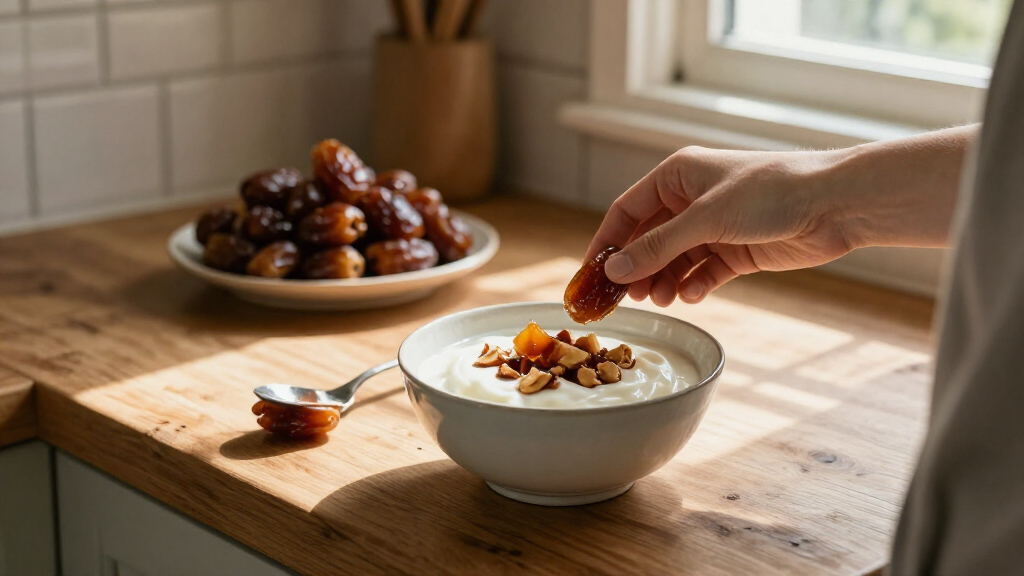
The report offers practical ways to use dates, including adding chopped fruit to oatmeal, yogurt or salads; blending dates into smoothies; and using them in homemade granola or energy bites. Blatner suggests pairing dates with nut butter, goat cheese or chopped nuts. These are serving ideas, not additional evidence that a particular recipe has a health effect.
People who choose to eat dates can check portion sizes against their needs and account for their natural sugar and calories. Remove the pit before eating whole dates, or buy pitted fruit. The source gives no new research or follow-up date; further health conclusions would require evidence beyond the nutrition profile and preliminary findings described in the report.
Key Questions
How many dates does the report describe as a serving?
Dietitian Dawn Jackson Blatner says two or three Medjool dates count as one serving. This is general guidance quoted in the report, not a personalized prescription.
Are dates high in sugar?
Yes. The report lists 64 grams of total sugar in four pitted Medjool dates. The figures are for that variety and portion; other dates and serving sizes may differ.
Do dates prevent heart disease or diabetes?
The report does not establish that dates prevent or treat either condition. It describes potential benefits related to fiber and antioxidants, which should not be treated as proof of a disease-prevention effect.
What are easy ways to eat dates?
The report suggests adding chopped dates to oatmeal, yogurt, salads or smoothies, or pairing them with nut butter, goat cheese or chopped nuts. Remove the pit before eating unless the dates are already pitted.
Source: rss