
When you’re shopping for stand mixers for baking, the big decision is usually between a KitchenAid’s proven build quality and a budget brand’s larger bowl at a lower cost. The KitchenAid Artisan 5-Quart (KSM150PS) stands out as the best overall pick for baking, thanks to a metal gear drive that handles stiff cookie and bread doughs year after year, plus a huge attachment ecosystem. For value, the Cuisinart SM-50R 12-Speed delivers more power and speed control than similarly priced tilt-head rivals, while compact bakers should look at the Kitchen in the Box 3.2 Qt for small kitchens and occasional batches. The core tradeoff: cheap 6-quart mixers look great on paper but can struggle or wobble under heavy dough, while premium machines cost far more up front. Keep reading for the full breakdown of all 15 models.

Get baking supplies delivered free with Prime
- Fast, free delivery on millions of items
- Prime Video, Amazon Music and more included
- Member-only deals all year
Complete the kit


Key Takeaways
- KitchenAid dominated the top of this comparison because of its all-metal gear train — every budget model here uses plastic components somewhere in the drive, which is where they falter on bread and stiff cookie doughs.
- Advertised wattage is misleading: the 660W Aucma and 591W Cuisinart don’t outperform the ~325W KitchenAid Artisan on heavy doughs because motor type and gearing matter more than raw watts.
- Bowl capacity isn’t usable capacity — a 6.3-quart OLIXIS or OSTBA bowl may still knead only one loaf’s worth of dough comfortably, while a 5-quart KitchenAid handles double batches of cookies with room to spare.
- This lineup contains near-duplicates at different prices: two KitchenAid Classic 4.5-Qt models (color is the only difference), two Artisan 5-Qt colors, two Kitchen in the Box 3.2 Qt units, and two Martha Stewart 5.3-Qt variants — pick on price per color, not specs.
- Small-capacity mixers like the 3.2-Qt Kitchen in the Box models are the only realistic choice for apartment bakers, but they’re rated for far less flour per batch and shouldn’t be expected to knead bread dough regularly.





| stand mixers for baking | Capacity | Bowl material | Speeds | Model |
|---|---|---|---|---|
| KitchenAid Artisan 5-Quart Til | 5 quarts | — | — | KSM150PSPT |
| Aucma 6.5-Qt 660W Tilt-Head St | — | Stainless steel | — | — |
| KitchenAid 5.5-Qt Bowl-Lift St | 5.5 qt | — | 11, including folding speed | KSM55SXXX |
| KitchenAid Classic Series 4.5- | 4.5 quarts | — | 10 | K45SS |
| VIVOHOME 6-Quart Tilt-Head Sta | 6 quarts | Stainless steel | 10 plus pulse | VH291-SL |
| OSTBA 6-Speed Tilt-Head Stand | — | Stainless steel | 6 plus pulse | — |
| Hamilton Beach 4-Quart Electri | — | Stainless steel | 7 | 63390 |
| Kitchen in the Box 3.2 Qt Stan | 3.2 qt | Stainless steel | 6 | — |
| Cuisinart 12-Speed Stand Mixer | 5.5 quarts | Stainless steel | — | SM-50R |
| Martha Stewart 5.3-Quart Tilt- | — | Stainless steel | — | — |
| OLIXIS 6.3 Qt 10-Speed Tilt-He | 6.3 Qt (4.2 Qt option available) | — | — | — |
| Martha Stewart 5.3-Quart Tilt- | — | Stainless steel | — | — |
| KitchenAid Artisan 5-Quart Til | 5 quarts | Stainless steel, dishwasher safe | 10 | KSM150PS |
| Kitchen in the Box 3.2 Qt Stan | 3.2 qt | Stainless steel | 6 | — |
| KitchenAid Classic Series 4.5- | 4.5 quarts | — | 10 | K45SSOB |
More Details on Our Top Picks
KitchenAid Artisan 5-Quart Tilt-Head Stand Mixer, KSM150PS, Pistachio
This is the pick I’d point most bakers toward first, because it balances capacity, build quality, and long-term versatility better than anything else here. The 5-quart bowl handles up to nine dozen cookies in a single batch, which covers holiday baking marathons without forcing you to work in rounds. Compared with the Aucma 6.5-Qt, the Artisan gives up a little raw capacity but trades it for KitchenAid’s metal construction and the hub-powered attachment ecosystem — pasta rollers, grinders, and more bolt onto the same machine for decades. The tilt-head design also makes scraping the bowl far less awkward than the bowl-lift mechanism on the KitchenAid 5.5-Qt. The tradeoff is real: it costs more than budget picks, and every hub attachment is sold separately, so the true price of a fully equipped kitchen climbs quickly.
Pros:- Durable all-metal construction built to last for years of heavy baking
- 5-quart bowl handles both small and large batches, up to 9 dozen cookies
- Dishwasher-safe stainless steel bowl with handle and included pouring shield
- Compatible with KitchenAid’s huge hub-powered attachment ecosystem
Cons:- Optional attachments like pasta rollers and grinders are sold separately
- Costs considerably more than comparable-capacity budget mixers
Best for: Serious home bakers who want a do-everything mixer that will survive a decade of weekly bread, cookie, and cake projects
Not ideal for: Budget-conscious buyers or occasional bakers — the premium buys durability and capacity they won’t fully use
- Model:KSM150PSPT
- Capacity:5 quarts
- Construction:Metal
- Speed settings:10
- Design:Tilt-head
- Bowl:Stainless steel with handle; dishwasher safe
- Included extras:Pouring shield
- Warranty:1-year hassle-free replacement
Our verdict“If you bake regularly and want one mixer that covers everything from whipped cream to bread dough for years, this is the one to buy.”
Aucma 6.5-Qt 660W Tilt-Head Stand Mixer with 6 Speeds
For bakers whose priority is sheer capacity per dollar, this Aucma is hard to beat. Its 6.5-quart bowl is the largest in this lineup — bigger than the KitchenAid Artisan’s 5 quarts — and the 660W motor has no trouble pushing through stiff bread dough. The included splash guard is something KitchenAid makes you buy separately, and it genuinely reduces flour-cloud mess during dry-ingredient additions. Where it falls short of the KitchenAid Classic 4.5-Qt is refinement: six speeds versus ten means less precision at the low end, so delicate tasks like folding meringue demand more attention. Build quality also leans lighter than KitchenAid’s all-metal construction, so heavy daily kneading may wear it faster. For weekend bakers making large batches without a premium budget, though, this model makes the most sense.
Pros:- Largest bowl in the lineup at 6.5 quarts with convenient handles
- Powerful 660W motor handles heavy bread dough
- Splash guard included, unlike pricier KitchenAid models
- Three mixing attachments cover whisking, beating, and kneading out of the box
Cons:- Only six speeds, limiting precision for delicate mixing tasks
- Attachments may require hand washing — dishwasher safety is not confirmed
- Lighter construction than all-metal premium mixers
Best for: Budget-minded bakers who regularly make large batches of bread dough or cookies and don’t need premium build refinement
Not ideal for: Bakers who work with delicate preparations like macarons or meringues — six speeds limit low-end control
- Motor power:660W
- Bowl capacity:6.5 qt
- Bowl material:Stainless steel
- Speed settings:6 speeds with pulse function
- Attachments:Whisk, dough hook, mixing beater
- Noise level:≤76 dB
- Design:Tilt-head
Our verdict“This is the smart pick if you want maximum bowl capacity and motor power without paying KitchenAid prices.”
KitchenAid 5.5-Qt Bowl-Lift Stand Mixer, KSM55SXXX, Porcelain White
When kneading is the main event, the bowl-lift design wins, and this KitchenAid is built for exactly that. It can power through over 7 pounds of bread dough or 11 dozen cookies in one go, and the three-point locking bowl keeps everything anchored when the dough resists — a stability advantage the tilt-head KitchenAid Artisan can’t match under similar strain. The 11 speeds include a gentle folding speed, giving it the finest low-end control in this batch, which matters for laminated doughs and fragile batters. The porcelain white finish also looks at home on an open counter. Be aware that bowl-lift mixers are heavier and taller, so lifting the bowl in and out takes more effort than tilting a head, and like every KitchenAid here, the additional attachments that make the platform so versatile are extra purchases.
Pros:- Handles over 7 lb of bread dough and up to 11 dozen cookies per batch
- Three-point locking bowl keeps the mixer stable under heavy loads
- 11 speeds including a gentle folding speed for delicate tasks
- Compatible with over 10 hub-powered attachments
Cons:- Additional attachments sold separately
- Bowl-lift design is heavier and less convenient for quick bowl access than tilt-head models
Best for: Frequent bread bakers and high-volume cookie makers who need serious dough capacity and rock-steady stability
Not ideal for: Bakers with limited counter space or who prioritize easy bowl access — bowl-lift designs are bulkier and less convenient than tilt-head models
- Model:KSM55SXXX
- Capacity:5.5 qt
- Mixer type:Bowl-lift
- Speeds:11, including folding speed
- Bowl:Stainless steel, three-point locking
- Included accessories:Coated flat beater, coated dough hook, 6-wire whip
- Batch capacity:11 dozen cookies; 7+ lb bread dough; 6 lb potatoes
Our verdict“If kneading large batches of bread dough is your priority, this bowl-lift workhorse earns its spot over every tilt-head option here.”
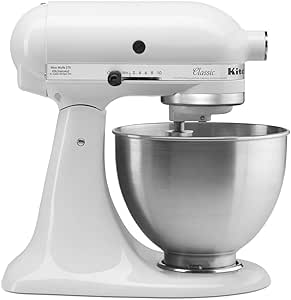
KitchenAid Classic Series 4.5-Quart Tilt-Head Stand Mixer, White
This is the most affordable way into KitchenAid’s platform, and that’s its entire value proposition. You get the same all-metal construction and attachment-hub compatibility as the pricier KitchenAid Artisan 5-Qt, meaning you can add a pasta roller or food grinder later without upgrading machines. The differences are practical rather than structural: the 4.5-quart bowl is half a quart smaller, so double batches of cookie dough can overflow, and there’s no pouring shield included. Compared with the VIVOHOME 6-Qt, you give up bowl capacity and motor wattage claims, but you gain a dishwasher-safe bowl and speed precision across ten settings. For someone buying their first real stand mixer with an eye on growing into the attachment ecosystem, this model makes more sense than spending extra on capacity you may not need yet.
Pros:- Durable metal construction shared with pricier KitchenAid models
- Dishwasher-safe stainless steel bowl
- 10 speeds cover everything from slow stirring to fast whipping
- Compatible with the full KitchenAid attachment hub ecosystem
Cons:- 4.5-quart capacity is the smallest among premium picks here
- Additional attachments and pouring shield sold separately
Best for: First-time stand mixer buyers who want KitchenAid durability and attachment compatibility at the lowest entry price
Not ideal for: High-volume bakers — the 4.5-quart bowl limits double batches and large bread dough recipes
- Model:K45SS
- Capacity:4.5 quarts
- Construction:Metal
- Speeds:10
- Bowl:Stainless steel; dishwasher safe
- Included attachments:Coated flat beater, coated dough hook, 6-wire whip
- Design:Tilt-head
Our verdict“Buy this if you want to join the KitchenAid ecosystem on a budget and mostly bake standard single batches.”
VIVOHOME 6-Quart Tilt-Head Stand Mixer, Silver
What makes this VIVOHOME interesting isn’t power — the Aucma 6.5-Qt matches its 660W motor — but everything bundled around it. You get 10 speeds plus pulse, a splash guard, suction cups for stability, a flex edge beater that continuously scrapes the bowl, and even an egg separator, all accessories that name-brand mixers charge extra for. At a stated 65 dB, it also runs quieter than the Aucma’s 76 dB ceiling, which matters if you bake early mornings. The flex edge beater is the standout: it eliminates the constant stop-and-scrape routine that standard beaters demand. The tradeoffs are weight and washability — at 12.5 pounds with suction feet, it’s awkward to reposition, and dishwasher safety for the attachments isn’t confirmed, so expect hand washing. Compared with a KitchenAid, you sacrifice build refinement and the attachment ecosystem, but the day-one package is generous.
Pros:- 10 speeds plus pulse give more control than 6-speed budget rivals
- Flex edge beater eliminates constant manual bowl scraping
- Suction cups and splash guard keep the mixer stable and mess contained
- Quieter operation at 65 dB with included egg separator
Cons:- Dishwasher safety of attachments is not specified, so hand washing is likely
- At 12.5 pounds with suction cups, it’s cumbersome to move and store
- No attachment ecosystem for expanding beyond basic mixing tasks
Best for: Hobby bakers who want a fully accessorized mixer with modern conveniences without paying premium-brand prices
Not ideal for: Bakers who plan to expand with pasta or grinder attachments — there’s no comparable ecosystem here
- Model:VH291-SL
- Capacity:6 quarts
- Motor power:660 watts
- Speeds:10 plus pulse
- Bowl material:Stainless steel
- Noise level:65 dB
- Special features:Tilt head, splash guard, suction cups, flex edge beater
- Dimensions:15.2 x 8.8 x 18.8 inches; 12.5 lb
Our verdict“Choose this if you want the most complete accessory package at a budget price and don’t care about expanding later.”
OSTBA 6-Speed Tilt-Head Stand Mixer with 6.3-Quart Bowl
This option stands out for what comes in the box rather than raw power. Alongside the usual dough hook, flat beater, and whisk, OSTBA includes a splash guard with measurement markings, a dough cutter, and an egg separator — small extras that genuinely reduce mess and prep steps for frequent bakers. The 6.3-quart stainless steel bowl matches the capacity of the OLIXIS 6.3 Qt model, but the OSTBA trades away speed granularity, offering six speeds plus pulse versus the finer control you get from a 12-speed machine like the Cuisinart SM-50R. The 300W motor is adequate for cookies and cakes, though it will strain on stiff bread doughs compared to higher-wattage options such as the Aucma 660W.
Pros:- Generous 6.3-quart stainless steel bowl for family-size batches
- Splash guard doubles as a measuring tool
- Dough cutter and egg separator included
- Pulse function adds control beyond the six base speeds
Cons:- 300W motor underperforms on heavy bread doughs
- Only six speeds limits precision for delicate tasks like meringue
Best for: Home bakers who want a large-capacity mixer with thoughtful included accessories at a budget-friendly price
Not ideal for: Bread bakers — the 300W motor lacks the power for repeated heavy dough kneading
- Motor:300W pure copper
- Bowl capacity:6.3 qt
- Bowl material:Stainless steel
- Speeds:6 plus pulse
- Attachments:Dough hook, flat beater, wire whisk
- Extras:Splash guard with measurements, dough cutter, egg separator
- Design:Tilt-head
Our verdict“This pick makes the most sense for casual bakers who value included accessories and bowl size over motor strength.”
Hamilton Beach 4-Quart Electric Stand Mixer with 7 Speeds
Hamilton Beach delivers something the budget competition often misses: true planetary mixing action, meaning the beater rotates around the bowl the same way premium mixers like the KitchenAid Classic Series do, so you rarely need to scrape by hand. Seven speeds give it more fine control than the six-speed OSTBA or Kitchen in the Box models, and the dishwasher-safe bowl makes cleanup painless. The tradeoff is capacity — at 4 quarts, it sits well below the 6-plus-quart budget options from OSTBA and OLIXIS, so double batches of cookie dough are out of the question. The 300-watt motor handles everyday cakes and frostings comfortably but is not built for marathon bread sessions.
Pros:- Planetary mixing action provides full bowl coverage without hand-scraping
- Seven speeds cover folding through whipping
- Three attachments plus splatter shield included
- Dishwasher-safe stainless steel bowl
Cons:- 4-quart capacity limits batch sizes
- 300-watt motor struggles with dense doughs
Best for: Couples and small households who bake weekly and want reliable planetary mixing without a premium price
Not ideal for: Batch bakers — the 4-quart bowl caps output well below what 6-quart competitors offer
- Brand:Hamilton Beach
- Model:63390
- Bowl capacity:4 quarts
- Motor power:300 watts
- Speeds:7
- Attachments:Dough hook, whisk, flat beater, splatter shield
- Bowl material:Stainless steel
- Warranty:One year
Our verdict“This model is better suited to small households that prioritize mixing performance per dollar over sheer capacity.”
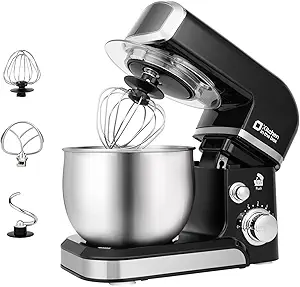
Kitchen in the Box 3.2 Qt Stand Mixer, 6 Speeds, Pink
Weighing under 7 pounds and fitting in roughly the footprint of a toaster, this is the mixer for kitchens where counter space is the scarcest ingredient. Compared with the Hamilton Beach 4-Quart, it gives up both capacity and planetary action, but it counters with true portability — it can live in a cabinet and come out for weekend baking. The four anti-slip suction cups do real work here, anchoring a lightweight body that would otherwise walk across the counter during kneading. Six speeds cover the basics, and the tilt-head design makes attachment swaps easy despite the small scale. Bakers making anything beyond a single loaf or one cake layer will find the 3.2-quart bowl the hard ceiling.
Pros:- Weighs under 7 lb for easy storage and portability
- Compact footprint suits tiny counters
- Suction cups keep it stable during mixing
- Includes three attachments and splash guard
Cons:- 3.2-quart capacity handles only small batches
- Lightweight build means less mixing power for heavy doughs
Best for: Apartment dwellers and occasional bakers with minimal counter space who need a storable, lightweight mixer
Not ideal for: Frequent or large-batch bakers — the small bowl and modest motor cap output and dough capacity
- Capacity:3.2 qt
- Speeds:6
- Weight:Less than 7 lb
- Dimensions:12.9 × 7 × 10.2 in
- Bowl material:Stainless steel
- Attachments:Dough hook, flat beater, stainless steel whisk, splash guard
- Stability:4 anti-slip suction cups
- Color:Pink
Our verdict“This option stands out as the space-saver’s choice — skip it if you regularly bake for a crowd.”
Cuisinart 12-Speed Stand Mixer, 5.5-Quart, Ruby Red (SM-50R)
Twelve speeds is the headline here, and for bakers that precision matters — the difference between a slow fold for muffin batter and a high whip for meringue is where six-speed models like the OSTBA feel blunt by comparison. The 500-watt motor doubles the output of budget picks and brings real credibility to bread dough, while the die-cast metal construction and 3-year warranty signal build quality closer to the KitchenAid bowl-lift tier than to plastic-bodied competitors. The 5.5-quart bowl sits right in the sweet spot between the 4-quart Hamilton Beach and the oversized 6.3-quart budget machines. The catch: the attachment hub unlocks pasta rollers and grinders, but those optional attachments cost extra, and the price of the base unit already runs above entry-level machines.
Pros:- 12 speeds enable precision from slow folding to fast whipping
- 500-watt motor handles bread dough with confidence
- Die-cast metal construction with 3-year warranty
- Attachment hub supports optional accessories
Cons:- Optional attachments sold separately add cost
- Heavier and pricier than entry-level alternatives
Best for: Serious home bakers who want fine speed control and a durable, expandable machine for diverse recipes
Not ideal for: Budget-focused buyers — the higher price and separately sold attachments inflate the real cost of ownership
- Brand:Cuisinart
- Model:SM-50R
- Capacity:5.5 quarts
- Motor power:500 watts
- Speed settings:12
- Bowl material:Stainless steel
- Construction:Die-cast metal
- Accessories:Chef’s whisk, dough hook, flat mixing paddle, splash guard with pour spout
- Warranty:3 years
Our verdict“Compared with similar options, this pick makes the most sense for bakers ready to invest in speed precision and long-term durability.”
Martha Stewart 5.3-Quart Tilt-Head Stand Mixer
Rated for up to 9 dozen cookies in a single batch, this mixer targets the holiday-baker crowd that smaller machines simply cannot serve. Its 5.3-quart bowl runs nearly a quart larger than the KitchenAid Artisan 5-Quart, and the flat beater with a silicone edge is a genuinely useful touch — it scrapes the bowl walls continuously, something the standard beaters on the OSTBA and Hamilton Beach require you to do by hand. Twelve speeds put it in the same control tier as the Cuisinart SM-50R, while dishwasher-safe, BPA-free accessories ease post-batch cleanup. The removable splash shield with pour chute keeps flour clouds contained. It lacks the Cuisinart’s attachment-ecosystem expandability, so buyers should weigh raw batch capability against long-term versatility.
Pros:- Handles up to 9 dozen cookies per batch
- Silicone-edge flat beater scrapes the bowl automatically
- 12 speeds offer precise control
- Dishwasher-safe, BPA-free accessories with removable splash shield
Cons:- No attachment hub for optional accessories
- Bulkier than compact models for small kitchens
Best for: Batch bakers and holiday cookie makers who need large capacity and hands-free bowl scraping
Not ideal for: Buyers who want an expandable ecosystem — there is no optional attachment hub like the Cuisinart offers
- Bowl capacity:5.3 quarts
- Bowl material:Stainless steel
- Speed settings:12
- Attachments:Stainless steel whisk, dough hook, flat beater with silicone edge
- Design:Tilt-head
- Splash shield:Removable, with pour chute
- Maximum batch size:Up to 9 dozen cookies
- Accessories:Dishwasher-safe, BPA-free
Our verdict“This model is better suited to high-volume bakers who prioritize batch size and smarter beater design over accessory expandability.”
OLIXIS 6.3 Qt 10-Speed Tilt-Head Stand Mixer
OLIXIS takes a different approach to value than most mixers in this roundup. Instead of pouring everything into motor power, it pairs a roomy 6.3-quart bowl with a genuinely unusual accessory: a bowl cover that integrates six kitchen tools, including a slicer, egg separator, and measuring cup. Compared with the OSTBA 6-Speed mixer, which offers a similarly sized bowl but a bare-bones accessory package, this option feels geared toward bakers who like all-in-one kits. The 300W motor is modest next to the Aucma 660W model, so stiff bread doughs will take longer and demand more patience. Ten speeds give decent control for whipping cream through kneading, and the tilt-head makes bowl changes quick.
Pros:- Large 6.3-quart bowl handles big batches of dough and batter
- Bowl cover integrates six bonus tools for prep convenience
- Ten speed settings cover whipping through kneading
- Available in a smaller 4.2-quart size if counter space is tight
Cons:- 300W motor is underpowered relative to the bowl size
- Multi-tool bowl cover adds cleaning complexity
- Brand lacks the track record of KitchenAid or Cuisinart for longevity
Best for: Budget-conscious home bakers who want a large-capacity mixer bundled with extra kitchen tools
Not ideal for: Frequent bread bakers — the 300W motor will strain on dense, yeast-heavy doughs compared to higher-wattage rivals
- Capacity:6.3 Qt (4.2 Qt option available)
- Motor power:300W
- Speed settings:10
- Design:Tilt-head
- Included attachments:Dough hook, wire whisk, flat beater
- Bowl cover tools:Magnifier, slicer, egg separator, measuring cup, scale, serrated edge
- Available colors:Black, Blue
Our verdict“This pick makes the most sense for casual bakers who value capacity and bundled accessories over raw mixing power.”
Martha Stewart 5.3-Quart Tilt-Head Stand Mixer, 12 Speeds
Where the OLIXIS leans on accessories, the Martha Stewart mixer leans on precision. Twelve speed settings — two more than the KitchenAid Artisan’s ten — give finer gradations between folding and full whip, which matters when a meringue needs a gentle ramp-up rather than a jump. The silicone-edged flat beater continuously scrapes the bowl walls, cutting down on stopping to spatula down the sides, something the standard coated beater on the KitchenAid Classic Series doesn’t do. A removable splash shield with a pour chute makes adding flour mid-mix far less messy. The tradeoff: this is a newer entry without the decades-long durability reputation KitchenAid has earned, and the lack of published dimensions makes it harder to plan counter space around.
Pros:- 12 speeds offer the finest control gradations in this batch
- Silicone-edged flat beater scrapes the bowl automatically
- Splash shield with pour chute reduces mess when adding ingredients
- 5.3-quart bowl handles batches up to 9 dozen cookies
Cons:- No published dimensions or weight makes kitchen planning difficult
- Newer product line with unproven long-term reliability
- Attachment ecosystem is limited compared to KitchenAid’s power hub options
Best for: Detail-oriented bakers who want maximum speed precision and a self-scraping beater for delicate recipes
Not ideal for: Buyers who prioritize proven long-term durability — this line is too new to match KitchenAid’s track record
- Bowl capacity:5.3 qt
- Bowl material:Stainless steel
- Speed settings:12
- Design:Tilt-head
- Attachments:Stainless steel whisk, dough hook, flat beater with silicone edge
- Splash shield:Removable, with pour chute
- Dishwasher safe:Yes, BPA-free accessories
Our verdict“A smart alternative to the Artisan for bakers who prize incremental speed control and a scraping beater over brand heritage.”
KitchenAid Artisan 5-Quart Tilt-Head Stand Mixer, KSM150PS, Almond Cream
This is the mixer the rest of the roundup is measured against, and it earns that status through full metal construction and an attachment ecosystem no rival here matches. The 5-quart capacity matches the Martha Stewart model’s practical output — both handle nine dozen cookies — but the Artisan’s power hub opens the door to pasta rollers, grinders, and spiralizers sold separately, turning it into a modular kitchen workhorse. Its all-metal gearing is where the price difference versus the VIVOHOME 6-Quart and OLIXIS becomes tangible: those mixers may match capacity on paper, but the Artisan is built to run for decades. The honest tradeoff is cost and weight — it is a significant investment compared to budget tilt-head models, and the coated beater included here lacks the silicone scraping edge the Martha Stewart mixer provides.
Pros:- Durable all-metal construction built for decades of use
- Power hub supports a huge range of optional attachments
- 5-quart bowl with handle handles up to 9 dozen cookies per batch
- Ten speeds with a proven direct-drive transmission
Cons:- Premium price relative to every other mixer in this roundup
- Standard coated beater requires manual scraping, unlike silicone-edged rivals
- Heavy enough that it is best left permanently on the counter
Best for: Serious home bakers who want a lifetime-grade mixer and plan to expand with attachments over time
Not ideal for: Occasional bakers on a budget — the premium is hard to justify for a few batches of cookies a year
- Model:KSM150PS
- Color:Almond Cream
- Capacity:5 quarts
- Bowl material:Stainless steel, dishwasher safe
- Speeds:10
- Construction:Metal
- Mixing capacity:Up to 9 dozen cookies per batch
Our verdict“If baking is a regular part of your life and you want one purchase to last, this is the pick that justifies its price.”
Kitchen in the Box 3.2 Qt Stand Mixer with Whisk, Dough Hook, and Flat Beater, Black
At under 7 pounds and roughly 13 inches wide, this mixer occupies a category nothing else in the lineup touches. The KitchenAid Artisan is a permanent counter fixture; the Kitchen in the Box can live in a cabinet and come out when needed, which changes the math entirely for apartment dwellers and RV kitchens. Compared with its pink sibling listed elsewhere in this roundup, it is functionally identical — color is the deciding factor there. Six speeds are fewer than the Martha Stewart’s twelve, but adequate for cookies, whipped cream, and cake batter. The honest limitation is capacity: 3.2 quarts means halving most standard recipes, and the aluminum dough hook and beater need hand-washing to avoid pitting, unlike the stainless attachments on pricier models.
Pros:- Under 7 lb and compact enough to store in a cabinet
- Splash guard and anti-slip suction cups keep operation tidy and stable
- Includes all three core attachments for mixing, whipping, and kneading
- Tilt-head design gives easy bowl access despite the small footprint
Cons:- 3.2-quart capacity requires halving most standard recipes
- Aluminum attachments need careful hand-washing to avoid damage
- Six speeds limit finesse for delicate tasks like meringue
Best for: Small-kitchen bakers, students, and RV or dorm cooks who bake in small batches
Not ideal for: Anyone baking for a family — the 3.2-quart bowl forces split batches on nearly every standard recipe
- Capacity:3.2 qt
- Weight:Less than 7 lb
- Dimensions:12.9 × 7 × 10.2 in
- Speeds:6
- Bowl material:Stainless steel
- Design:Tilt head
- Attachments:Aluminum dough hook and flat beater; stainless steel whisk
- Color:Black
Our verdict“This is the right choice when counter and storage space matter more than batch size.”
KitchenAid Classic Series 4.5-Quart Tilt-Head Stand Mixer, Onyx Black
Think of this as the Artisan’s more practical sibling: same metal construction, same ten speeds, same power hub ecosystem, but a half-quart smaller bowl and a friendlier price. That trade makes sense for many bakers — 4.5 quarts still handles standard cookie and cake batches, and you keep access to the optional attachment ecosystem (pasta rollers, grinders, and more) that no other brand in this roundup can match. Compared with the Hamilton Beach 4-Quart, the Classic offers real metal gearing and a much longer expected lifespan, which is where its extra cost pays off. The drawbacks are real though: the coated beaters wear faster than stainless ones, and every meaningful attachment is a separate purchase, so the total cost of building it out creeps upward quickly.
Pros:- Same all-metal construction and power hub as pricier KitchenAid models
- 4.5-quart bowl suits standard cake and cookie recipes
- Dishwasher-safe stainless bowl simplifies cleanup
- Ten speeds cover everything from slow folding to fast whipping
Cons:- All useful attachments are sold separately and add up quickly
- Coated beater and dough hook wear faster than stainless alternatives
- Smaller capacity than most similarly priced competitors in this roundup
Best for: First-time KitchenAid buyers who want the build quality and attachment ecosystem without the Artisan’s price
Not ideal for: Frequent large-batch bakers — the 4.5-quart bowl is noticeably tighter than 5-plus-quart rivals like the Aucma or Martha Stewart
- Model:K45SSOB
- Capacity:4.5 quarts
- Color:Onyx Black
- Construction:Metal
- Speeds:10
- Bowl:Stainless steel, dishwasher safe
- Included accessories:Coated flat beater, coated dough hook, 6-wire whip
- Warranty:1-year limited
Our verdict“The smartest way into the KitchenAid ecosystem if the Artisan’s price gives you pause and 4.5 quarts covers your typical batch.”

How We Picked
I evaluated these 15 stand mixers through a baker’s lens rather than a spec sheet. The four criteria that shaped the ranking were dough-handling ability (can it knead bread without straining or walking across the counter?), bowl capacity relative to realistic batch sizes, build quality of the drive train and head mechanism, and value for money within each capacity class. I also weighed versatility — attachment ecosystems, bowl-lift versus tilt-head ergonomics, and speed control precision — because whipping meringue and creaming butter demand very different things from a mixer than kneading does.
The ranking logic follows a simple principle: for baking specifically, durability under load beats raw features. That’s why KitchenAid models sit near the top despite modest wattage numbers, and why big-bowl budget mixers rank mid-pack rather than high — a 6.3-quart bowl means little if the machine struggles with the dough that fills it. Where two models are functionally identical (the repeated KitchenAid and Martha Stewart colorways), I treated them as one pick and noted the differences so you don’t pay a premium for paint.
| stand mixers for baking | Design | Bowl material |
|---|---|---|
| KitchenAid Artisan 5-Quart Til | Tilt-head | — |
| Aucma 6.5-Qt 660W Tilt-Head St | Tilt-head | Stainless steel |
| KitchenAid 5.5-Qt Bowl-Lift St | — | — |
| KitchenAid Classic Series 4.5- | Tilt-head | — |
| VIVOHOME 6-Quart Tilt-Head Sta | — | Stainless steel |
| OSTBA 6-Speed Tilt-Head Stand | Tilt-head | Stainless steel |
| Hamilton Beach 4-Quart Electri | — | Stainless steel |
| Kitchen in the Box 3.2 Qt Stan | — | Stainless steel |
| Cuisinart 12-Speed Stand Mixer | — | Stainless steel |
| Martha Stewart 5.3-Quart Tilt- | Tilt-head | Stainless steel |
| OLIXIS 6.3 Qt 10-Speed Tilt-He | Tilt-head | — |
| Martha Stewart 5.3-Quart Tilt- | Tilt-head | Stainless steel |
| KitchenAid Artisan 5-Quart Til | — | Stainless steel, dishwasher safe |
| Kitchen in the Box 3.2 Qt Stan | Tilt head | Stainless steel |
| KitchenAid Classic Series 4.5- | — | — |
Factors to Consider When Choosing Stand Mixers For Baking
Beyond the individual models, a few category-wide realities will shape whether you’re happy with your mixer two years from now. These are the mistakes and tradeoffs I see buyers run into most often.Motor Watts Are the Worst Way to Compare Mixers
Almost every budget mixer in this class advertises a big wattage number, and almost none of them tell you what that wattage actually measures. In direct-drive mixers like the KitchenAid Artisan, a modest 325W motor delivers more usable torque at the beater than a 660W motor driving through plastic gears in a cheap tilt-head. What matters is the power delivered at the attachment, not consumed at the wall. A good rule: if a mixer’s marketing leans hard on watts and says little about its gear train or duty cycle, be skeptical. Look instead for metal gearing, stated flour-capacity ratings, and how the manufacturer describes continuous-run time. This single insight explains most of the ranking order in this roundup.
Match Bowl Size to What You Actually Bake
Buyers consistently overbuy capacity. If your typical batch is two dozen cookies or a single loaf of bread, a 5-quart bowl is plenty and a 4.5-quart works fine — a bigger bowl just means ingredients splash around an under-filled mixing zone and beaters struggle to reach them. Conversely, if you bake for events or make double batches of pizza dough, sub-5-quart bowls force you into multiple rounds of mixing. A useful benchmark: a 5-quart bowl handles about 4 cups of flour for yeast dough and roughly 8–9 cups for cookies; 3.2-quart models handle roughly half that. Be honest about your real weekly output before paying a premium for capacity you’ll never fill.
Tilt-Head vs. Bowl-Lift Is an Ergonomics Decision
Tilt-head mixers (most of this list) make it easy to add ingredients and swap bowls, but the head hinge is a structural weak point under heavy dough — this is where cheap models flex and wobble. Bowl-lift designs, like the KitchenAid 5.5-Qt KSM55SXXX, anchor the bowl between two arms and keep the mixing head rigid, which is why they’re the standard for larger-capacity machines. The tradeoff: bowl-lift models are taller, heavier, harder to store, and adding ingredients mid-mix is more awkward. If you knead bread weekly, the rigidity is worth it. If you mostly cream butter and whip cream, a tilt-head is more convenient and costs less at equal capacity.
The Attachment Ecosystem Is a Hidden Cost or a Hidden Bonus
KitchenAid’s power hub is the reason many bakers pay more up front: pasta rollers, meat grinders, grain mills, and ice cream makers all mount to the front hub, effectively turning one purchase into a modular kitchen system. Budget brands in this roundup — Aucma, VIVOHOME, OSTBA, OLIXIS — have no meaningful attachment ecosystem, so what you buy is what you get. That’s fine if you only need a mixer, but if there’s a pasta roller or grain mill in your future, buying into a proprietary hub-free brand means buying separate appliances later. Factor the five-year view, not just the day-one price tag, into which platform you choose.
Where Cheap Mixers Actually Fail
Budget stand mixers rarely fail at whipping or mixing cake batter — they fail at repeated dough work. The failure points are predictable: plastic gears strip, tilt-head pivots develop slop and wobble, and suction feet let the machine walk on the counter under load. If you bake bread more than once a month, this is where spending more pays for itself, because a stripped gear at month ten costs more than the price gap to a metal-geared machine. If you bake occasional cookies and brownies, a $70–120 mixer is a genuinely reasonable purchase and paying four times as much would be wasted money. Match the machine to the workload, not to aspiration.
Watch for Duplicate Models at Different Prices
This category is full of identical machines sold under different listings, and this roundup alone contains several pairs. The two KitchenAid Classic 4.5-Qt picks differ only in color, as do the two Artisan 5-Qt models and the two Kitchen in the Box 3.2-Qt units. The two Martha Stewart 5.3-Qt mixers differ mainly in speed count, which matters slightly for delicate tasks. Retailers know certain colors trend and price them accordingly — Porcelain White and Pistachio finishes often command a premium over Onyx Black at the same specs. If you’re flexible on color, that flexibility is worth real money on functionally identical machines.
Frequently Asked Questions
Can a cheap 6-quart stand mixer really handle bread dough?
It depends on frequency. Big-bowl budget mixers like the OLIXIS 6.3-Qt and OSTBA can knead a single loaf occasionally, but their plastic-geared drivetrains and lighter builds mean daily bread work will wear them out fast — expect wobble at the tilt-head pivot and eventual gear wear. The other limiting factor is flour capacity: despite the large bowl, most are only rated for around 1 kg of flour, which isn’t much more than a KitchenAid Artisan handles with far sturdier internals. If bread is a once-a-month project, they’re fine. If you bake yeast dough weekly, a metal-geared machine like the KitchenAid bowl-lift KSM55SXXX will save you from buying a replacement within a couple of years.
Is the KitchenAid Classic 4.5-Quart enough, or should I step up to the Artisan 5-Quart?
The Classic’s 250W motor and smaller bowl are adequate for cookies, cakes, whipped cream, and occasional soft doughs, and it’s the smart buy if that describes your baking. The Artisan’s advantages are real but specific: more power for stiff doughs, half a quart more capacity, a pouring shield in the box, and the wider color range and finish quality KitchenAid is known for. Neither is a bread machine — both tilt-head models strain on large yeast batches. My guidance: choose the Classic if you bake desserts for a household of one to four people, and pay the extra for the Artisan only if you regularly make double cookie batches or firmer doughs and want the machine to last decades rather than years.
Why are there two identical mixers in different colors listed at different prices?
Color pricing is a genuine phenomenon in this category, and this roundup includes several examples. The Onyx Black KitchenAid Classic and the White version are mechanically identical, as are the Almond Cream and Pistachio Artisan models — yet limited or trendy finishes often sell for noticeably more because inventory is thinner and demand is fashion-driven. Nothing about the motor, bowl, or gears changes between colorways. If you’re flexible on aesthetics, the neutral color is usually the value play; if a specific finish matches your kitchen and makes you happy, that premium is a lifestyle choice rather than a performance one. Either way, don’t mistake the pricier color for the better machine.
Is a 3.2-quart mini stand mixer a serious tool or a gimmick?
For the right baker, it’s serious. The Kitchen in the Box 3.2-Qt models make sense for single-person households, small apartments, RV kitchens, or anyone whose baking is limited to a batch of brownies or a small cake — they store easily, weigh little, and cost a fraction of a full-size machine. The limits are equally real: they max out around 2 cups of flour for dough, can’t handle a standard cookie recipe in one go without splitting batches, and shouldn’t be asked to knead bread regularly. Small capacity also makes small batches tricky, since beaters can struggle to reach ingredients at the bowl’s bottom. Treat them as capable small-batch tools, not scaled-down versions of a full mixer.
What speed range do I actually need for baking?
Fewer speeds than you’d think, but the low end matters more than the high end. Six speeds — the count on the Aucma, OSTBA, and Kitchen in the Box models — covers every baking task: a slow stir to incorporate flour without a dust cloud, medium speeds for creaming and kneading, and high for whipping. The Cuisinart’s 12 speeds and the Martha Stewart’s 12-speed version offer finer control at the slow end, which helps with folding or gently starting a meringue, but that refinement is a convenience rather than a capability gap. What I’d look for instead is a smooth, gradual speed dial or buttons — some budget mixers jump abruptly between speeds and splash flour on the first click. If two mixers differ mainly in speed count, prioritize build over the number.
Conclusion
After comparing all 15 models, the recommendations break down cleanly by baker type. For the best overall, the KitchenAid Artisan 5-Quart (KSM150PS) wins on proven durability, balanced capacity, and the attachment ecosystem that keeps it useful for decades — choose whichever colorway costs less. The best value pick is the Cuisinart SM-50R 12-Speed, which brings genuine power and precision speed control at a mid-tier price, outclassing the budget 6-quart brands on everything but bowl size. For premium buyers who knead bread regularly or bake in volume, the KitchenAid 5.5-Qt Bowl-Lift (KSM55SXXX) is the only machine here built for relentless dough work without head wobble.
For beginners and casual bakers, the Hamilton Beach 4-Quart is the low-risk entry point that covers cookies and cakes without a steep investment, while the KitchenAid Classic 4.5-Quart suits beginners who want their first mixer to also be their last. For small kitchens and single-person households, the Kitchen in the Box 3.2-Qt is the specific-needs choice — just don’t ask it to make bread. And if you want maximum bowl size on a tight budget, the Aucma 6.5-Qt or OLIXIS 6.3-Qt will serve, provided your baking stays on the lighter side. Whatever your pick, match the machine to your real baking habits — that’s the decision that determines satisfaction more than any spec on the box.