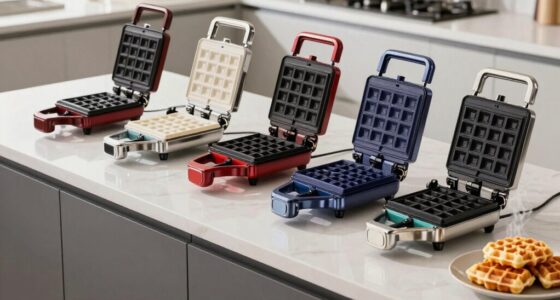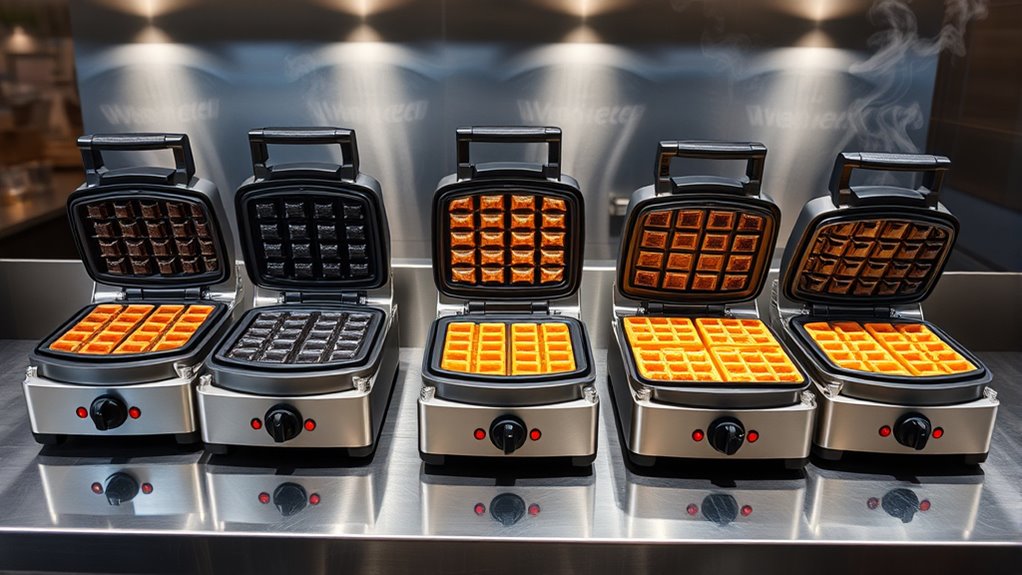

Choosing a commercial waffle maker comes down to matching the machine’s output and electrical needs to the way your kitchen works. I’d start with the VEVOR 10-waffle maker for batch production, the VEVOR dual-head round model for two independently controlled waffles at once, or the CROSSON rotating model for single-waffle service with a 120V connection. Each solves a different bottleneck, so capacity alone should not decide the purchase.

Get baking supplies delivered free with Prime
- Fast, free delivery on millions of items
- Prime Video, Amazon Music and more included
- Member-only deals all year
The tradeoffs are practical: higher output takes more counter space, rotation adds handling steps, and a listed voltage can rule out a machine before its cooking features matter. I also include the Cuisinart Double Flip as a lighter-duty two-waffle alternative, while the VEVOR 360-degree rotatable model is worth a look only if your kitchen can supply 220V. My ranking favors usable production capacity and clear fit over claims that sound impressive on paper.
Complete the kit


Key Takeaways
- For batches of ten rectangular waffles, the 1550W VEVOR 10-waffle model has the largest stated capacity, though it is excessive for low-volume service.
- The 2460W VEVOR dual-head model cooks two round waffles at once and gives each head its own temperature control, but it needs substantial counter space.
- The CROSSON rotating Belgian maker is the most straightforward commercial-style single-waffle pick here for a 120V setup, with a five-minute timer and 180-degree rotation.
- The VEVOR 360-degree rotatable model is a 220V appliance, so buyers should confirm outlet compatibility before choosing it.
- The Cuisinart makes two thick Belgian waffles with five shade settings and a dishwasher-safe drip tray, but it is better suited to lighter-duty use than batch production.
| VEVOR Commercial 10-Waffle Belgian Waffle Maker |  | Best for batch production | Wattage: 1550W | Voltage: 120V | Capacity: 10 rectangular waffles | VIEW ON AMAZON | See Our Full Breakdown |
| VEVOR Commercial Waffle Maker, Dual-Head Round Waffle Baker Machine |  | Best for two-waffle service with separate controls | Wattage: 2460W | Voltage: 120V | Heads: 2 | VIEW ON AMAZON | See Our Full Breakdown |
| CROSSON Commercial Rotating Belgian Waffle Maker, 1300W |  | Best overall single-head commercial-style pick | Brand and model: CROSSON RWM-180C | Voltage: 120V | Power: 1300W | VIEW ON AMAZON | See Our Full Breakdown |
| Cuisinart Double Flip Belgian Waffle Maker, 2 Waffles, WAF-F40NAS |  | Best for lower-volume two-waffle service | Model: WAF-F40NAS | Power: 1400W | Capacity: 2 waffles per cycle | VIEW ON AMAZON | See Our Full Breakdown |
| VEVOR Commercial Rotatable Round Waffle Maker, 1300W |  | Best for 220V kitchens wanting a rotatable round iron | Wattage: 1300W | Voltage: 220V | Temperature range: 122–572°F (50–300°C) | VIEW ON AMAZON | See Our Full Breakdown |
| commercial waffle maker | Voltage | Wattage | Temperature range | Body |
|---|---|---|---|---|
| VEVOR Commercial 10-Waffle Bel | 120V | 1550W | 122–572°F (50–300°C) | Stainless steel |
| VEVOR Commercial Waffle Maker | 120V | 2460W | 122–572°F | — |
| CROSSON Commercial Rotating Be | 120V | — | — | Stainless steel |
| Cuisinart Double Flip Belgian | — | — | — | — |
| VEVOR Commercial Rotatable Rou | 220V | 1300W | 122–572°F (50–300°C) | Stainless steel |
More Details on Our Top Picks
VEVOR Commercial 10-Waffle Belgian Waffle Maker
When one waffle at a time creates a service bottleneck, the VEVOR 10-waffle maker is the clearest capacity choice in this group. Its rectangular plates bake ten waffles in a cycle, a substantially different use case from the CROSSON and VEVOR rotating round models, which focus on a single waffle, or the Cuisinart and dual-head VEVOR, which make two. That batch format can simplify prep for a café, buffet, or event kitchen where waffles are served in volume.
The machine runs at 1550W on 120V and has an adjustable temperature range from 122°F to 572°F. That range gives an operator room to tune browning and texture, while non-stick plates and spill channels address the cleanup burden that comes with repeated batches. Rubber feet help keep the larger machine steady during use. Compared with the dual-head VEVOR, it prioritizes batch count over independent control of two separate waffles; compared with the rotating Belgian models, it produces multiple rectangular portions rather than a single thick round waffle.
Its advantage is also its limitation. A ten-waffle plate can be more machine than a small operation needs, and the supplied description does not specify a timer duration or the full waffle dimensions. I would confirm that the portion size and plate layout match the menu before buying. The one-year limited warranty is stated, but operators should also plan for counter space and a workflow that can use a full batch rather than leaving waffles waiting.
Pros:- Ten-waffle capacity supports batch service.
- Adjustable temperature control covers a broad stated range.
- Non-stick plates and spill channels can reduce cleanup effort.
- Rubber feet support steadier countertop operation.
Cons:- Its high capacity may be unnecessary for small operations.
- The supplied description does not specify timer duration.
- Waffle dimensions are not fully detailed.
Best for: Cafés, buffets, and event kitchens that need to cook multiple rectangular waffles in one batch.
Not ideal for: Small households or low-volume counters that cannot use ten waffles at once or have limited room for a batch machine.
- Wattage:1550W
- Voltage:120V
- Capacity:10 rectangular waffles
- Temperature range:122–572°F (50–300°C)
- Plate coating:Non-stick
- Body:Stainless steel
- Warranty:1-year limited
Our verdict“I rank this first for kitchens that genuinely need ten rectangular waffles per cycle, but its batch-focused format is a poor match for small or occasional service.”
VEVOR Commercial Waffle Maker, Dual-Head Round Waffle Baker Machine
The dual-head VEVOR is my pick when a kitchen wants two round Belgian waffles at once but still needs control over each cooking head. Its dual independent temperature controls are the feature that sets it apart from the 10-waffle VEVOR: the latter has the larger stated batch capacity, while this machine lets an operator adjust two waffles separately. That can help when orders call for different browning levels or when one head needs a different setting during service.
At 2460W and 120V, it has the highest listed wattage in this lineup. The maker describes rapid cooking, and its non-stick stainless-steel plates and spill channels address the practical mess of a two-head station. Rubber feet and stainless-steel handles add stability and grip. Compared with the CROSSON, which rotates a single waffle and includes a timer, this model favors simultaneous output and independent temperature adjustment over a specified timer and a compact single-head arrangement. Its footprint, 19.69 by 18.5 by 10.24 inches, makes that production capacity visible on the counter.
The tradeoff is that the large, heavy unit can be awkward to reposition and may occupy too much space for a compact kitchen. Its stated temperature range is 122°F to 572°F, which may not suit every specialty recipe. Buyers should check their available counter area and confirm that the two-head workflow matches real demand; if they only need occasional waffles, the lighter Cuisinart may be easier to accommodate, though it is not the same commercial-style station.
Pros:- Two heads cook round waffles simultaneously.
- Independent temperature controls allow different settings for each waffle.
- Non-stick plates and spill channels support easier cleanup.
- Rubber feet and stainless-steel handles aid stability and handling.
Cons:- Large footprint can crowd a working counter.
- At 21.4 pounds, it is difficult to move frequently.
- The stated temperature ceiling may not suit some specialty recipes.
Best for: Small restaurants and snack bars that serve two round waffles at once and value separate temperature control for each head.
Not ideal for: Kitchens with little counter space, operators who need a lightweight portable appliance, or menus requiring temperatures beyond the stated range.
- Wattage:2460W
- Voltage:120V
- Heads:2
- Temperature range:122–572°F
- Dimensions:19.69 × 18.5 × 10.24 in
- Weight:21.4 lb
- Finish:Silver
Our verdict“I recommend this for two-waffle service where independent controls matter more than a smaller footprint or the larger batch capacity of the 10-waffle VEVOR.”
CROSSON Commercial Rotating Belgian Waffle Maker, 1300W
The CROSSON earns my overall pick for a buyer who wants a single rotating Belgian waffle maker with a clearly stated 120V connection and controls designed around repeat service. Its 180-degree rotation helps move batter across the plates, while dual upper and lower heating plates are intended to cook from both sides. Unlike the VEVOR 10-waffle unit, it does not chase batch capacity; unlike the dual-head model, it does not cook two separate waffles. Its role is a focused one-waffle station.
The 1300W stainless-steel machine includes adjustable temperature, rear-mounted controls, and a five-minute timer with automatic shutoff or continuous operation. Rear placement can keep the controls less exposed to batter and crumbs than controls located in the main working area. The timer modes also give the operator a choice between a timed cycle and continuous use. In comparison, the VEVOR 360-degree rotatable model offers a full rotation and ready/beep lights, but its listed 220V requirement makes the CROSSON the easier fit for kitchens set up for 120V.
There are meaningful limits. A five-minute timer may not suit recipes or workflows needing longer timed cycles, and the triple-layer non-stick coating needs careful handling to avoid damage. It also has only one waffle per cycle, so this is not the choice for a rush that depends on parallel cooking. I would choose it over the Cuisinart when a commercial-oriented 120V rotating unit and continuous operation matter more than two-waffle capacity, but I would choose the Cuisinart for two waffles per cycle and a dishwasher-safe drip tray.
Pros:- 180-degree rotation helps spread batter across the plates.
- Dual heating plates support cooking from both sides.
- Rear-mounted controls are less exposed to spills and crumbs.
- Timer includes automatic shutoff and continuous modes.
Cons:- Timer is limited to five minutes.
- Non-stick coating requires careful handling.
- Single-waffle capacity limits throughput.
Best for: A small café or food counter that needs one rotating Belgian waffle at a time, rear controls, and a 120V connection.
Not ideal for: High-volume service that needs several waffles at once, or recipes that need timed cycles longer than five minutes.
- Brand and model:CROSSON RWM-180C
- Voltage:120V
- Power:1300W
- Rotation:180°
- Heating:Dual upper and lower plates
- Coating:Triple-layer non-stick Teflon
- Timer:5 minutes; automatic shutoff or continuous mode
- Body:Stainless steel
Our verdict“I’d choose the CROSSON for a 120V single-waffle station with rotation and practical timer modes, rather than for bulk output.”
Cuisinart Double Flip Belgian Waffle Maker, 2 Waffles, WAF-F40NAS
The Cuisinart Double Flip suits an operator who wants two thick Belgian waffles per cycle without moving up to the large, heavy dual-head VEVOR. Its 1400W heating element and rotary 180-degree flip are designed to distribute batter into the waffle pockets, while five shade settings make it easier to select a preferred finish. The comparison is straightforward: the VEVOR dual-head model is positioned more firmly around commercial use and has independent temperature controls; this Cuisinart emphasizes two-waffle capacity, adjustable shade, and a manageable listed weight of 9.25 pounds.
Cleanup is a strength on paper. A removable dishwasher-safe stainless-steel drip tray catches overflow and can be washed separately, and the plates have a ceramic non-stick coating. Its three-year limited warranty is longer than the one-year limited warranty listed for the VEVOR 10-waffle unit and VEVOR 360-degree model. I’d see this as a useful fit for a small café, guest-service area, or a kitchen with moderate waffle demand—not as a replacement for a ten-waffle batch plate.
The main drawback is the wide, long footprint: listed dimensions are 19.79 by 8.35 by 15.11 inches, so its shape may be inconvenient on a narrow counter despite its relatively low weight. It also lacks the independent head controls of the dual-head VEVOR, and the supplied details do not frame it as a heavy-duty batch appliance. Buyers should compare the exact intended duty and available space rather than treating two waffles per cycle as equivalent to a dedicated commercial production machine.
Pros:- Cooks two full, one-inch-thick Belgian waffles per cycle.
- Rotary flip design helps distribute batter into deep pockets.
- Five shade settings provide a choice of finish.
- Dishwasher-safe stainless-steel drip tray simplifies cleanup.
Cons:- Its long footprint may not suit narrow counters.
- It lacks the independent head temperature controls of the dual-head VEVOR.
- Two-waffle capacity is limited for batch-focused service.
Best for: Small food-service counters and lower-volume kitchens that want two Belgian waffles per cycle, shade choices, and a removable drip tray.
Not ideal for: High-throughput operations that need batch capacity or separate temperature controls for each waffle.
- Model:WAF-F40NAS
- Power:1400W
- Capacity:2 waffles per cycle
- Dimensions:19.79 × 8.35 × 15.11 in
- Weight:9.25 lb
- Shade settings:5
- Plate coating:Ceramic non-stick
- Warranty:3-year limited
Our verdict“I’d pick the Cuisinart for modest two-waffle service and easy drip-tray cleanup, but not for a kitchen that needs commercial batch output.”
VEVOR Commercial Rotatable Round Waffle Maker, 1300W
This VEVOR is the most natural alternative to the CROSSON for a buyer who wants a rotating round waffle maker, but the electrical requirement changes the decision. It lists 220V, whereas the CROSSON is specified for 120V. That difference should come before questions about controls or footprint: a kitchen needs a compatible supply for this model. If the power setup is right, the 360-degree rotation, adjustable temperature, and ready and beep lights offer a clear operator-facing set of features.
At 1300W with six settings and a stated temperature range of 122°F to 572°F, it can be adjusted for different browning preferences. The non-stick surface and batter overflow groove are intended to make release and cleanup easier, while the stainless-steel body suits a countertop food-prep setting. Compared with the CROSSON, its rotation is listed as 360 degrees and it adds indicator lights, but the CROSSON has dual heating plates, rear-mounted controls, and timer modes. Compared with the Cuisinart, this VEVOR focuses on one rotatable round waffle rather than two waffles with five shade settings.
The stated dimensions of 15 by 9.8 by 12 inches look more manageable than the dual-head VEVOR’s footprint, but its 18.8-pound weight makes frequent moving less convenient. It also carries a one-year limited warranty. The main gate is voltage, followed by the fact that it still cooks one waffle at a time. I would not buy it for a 120V-only station on the strength of its compact design; the CROSSON is the more practical option for that setup.
Pros:- 360-degree rotation supports batter distribution across the cooking surface.
- Ready and beep lights provide operating cues.
- Six temperature settings and a broad stated range allow adjustment.
- Overflow groove and non-stick surface support easier cleanup.
Cons:- Requires a 220V power supply.
- Weighs 18.8 pounds, which makes frequent movement inconvenient.
- One-waffle capacity is not suited to batch service.
Best for: A kitchen with a compatible 220V supply that wants a single round waffle maker with rotation, adjustable temperature, and readiness signals.
Not ideal for: Kitchens limited to 120V outlets, buyers who need multiple waffles per cycle, or anyone seeking a lightweight machine to move often.
- Wattage:1300W
- Voltage:220V
- Temperature range:122–572°F (50–300°C)
- Settings:6
- Dimensions:15 × 9.8 × 12 in
- Weight:18.8 lb
- Body:Stainless steel
- Warranty:1-year limited
Our verdict“I’d consider this model only after confirming 220V compatibility; with the right outlet, it offers a compact-footprint rotating alternative to the 120V CROSSON.”

How We Picked
I ranked these machines around the decisions that matter in a working waffle station: how many waffles can be cooked at once, what kind of waffle the plates make, and whether the listed power requirements fit a typical kitchen. A commercial label by itself does not tell me whether a product can keep up with a breakfast rush, fit on a crowded counter, or connect to the available outlet.
Capacity and controls shaped the order. The VEVOR 10-waffle unit leads for batch output; the dual-head VEVOR follows for two simultaneous round waffles with separate temperature settings. The CROSSON earns a place near the top because its 120V, 1300W configuration, 180-degree rotation, timer, and commercial-oriented stainless body make its operating role relatively clear. These three are not interchangeable: one produces a batch of rectangular waffles, one handles two independently controlled round waffles, and one focuses on a single rotating Belgian waffle.
I also included the Cuisinart because two-waffle capacity, shade settings, ceramic non-stick plates, and its removable dishwasher-safe drip tray may suit a small café or a lower-volume station, even though its feature set is less production-focused. The VEVOR 360-degree model rounds out the list for kitchens that want a rotating round waffle iron and can supply 220V. Its voltage requirement limits its fit, regardless of its compact dimensions.
For every pick, I weighed the supplied specifications and noted where details were absent. For example, the 10-waffle model’s description does not give a timer duration or clear waffle dimensions, and the CROSSON timer tops out at five minutes. I did not treat wattage as a complete measure of performance: outlet compatibility, actual service volume, cleanup, and footprint matter just as much. The order reflects the strongest fit for defined commercial tasks, not a claim that one machine is right for every business.
Factors to Consider When Choosing Commercial Waffle Maker
I’d choose a commercial waffle maker by working backward from the order pattern: how many waffles need to be ready together, what shape the menu calls for, and what electrical service the counter can supply. Those answers narrow this particular group faster than comparing wattage alone.
Match capacity to the rush
The biggest distinction in this lineup is ten waffles versus two versus one. The VEVOR 10-waffle machine makes sense when a batch can be served or held as part of a planned workflow. The dual-head VEVOR and Cuisinart both make two waffles per cycle, but they differ in controls and commercial emphasis: the VEVOR has independent temperature settings, while the Cuisinart gives five shade choices and a removable dishwasher-safe tray. The CROSSON and 360-degree VEVOR are single-waffle machines, so their fit depends on a slower or more specialized service rhythm. I would avoid buying capacity that the kitchen cannot use; a full plate is not an advantage if orders arrive one at a time and finished waffles wait too long.
Check voltage before comparing features
Electrical compatibility is a hard filter, not a minor spec. The CROSSON, both VEVOR machines intended for 120V use, and the Cuisinart list 120V or power information consistent with that configuration in the supplied details; the rotatable VEVOR explicitly requires 220V. Confirm the outlet, circuit, and installation plan with the equipment documentation and a qualified electrician where needed. Wattage also matters to the station’s electrical load, but it should not be read as a guaranteed measure of cooking speed or finished-waffle quality. The 2460W dual-head VEVOR has the highest listed wattage, yet the right choice still depends on outlet capacity and how its two-head output fits the menu.
Choose the plate format for the menu
Plate shape affects portioning, presentation, and how many servings a cycle represents. The VEVOR batch model makes ten rectangular waffles, while the rotating models are round Belgian-style machines. The Cuisinart makes two one-inch-thick Belgian waffles, and the dual-head VEVOR is described as a round waffle baker. Before buying, confirm dimensions and portion size against the plates, since the 10-waffle product description does not fully specify waffle dimensions. A machine that produces the wrong format can create extra cutting, different plating, or a mismatch with the menu even if its capacity appears attractive.
Decide whether rotation and independent controls help
Rotation is intended to spread batter through the cooking plates, but it is not a substitute for sufficient capacity or a good service routine. The CROSSON rotates 180 degrees and has dual heating plates; the VEVOR round model lists 360-degree rotation and ready/beep lights; the Cuisinart also flips 180 degrees and offers five shade settings. For two simultaneous waffles with separate temperatures, the dual-head VEVOR has the clearest advantage. I would pay attention to which control addresses the actual need: a timer helps with repeat cycles, shade settings support a simple finish preference, and independent controls matter when two heads need different settings.
Plan for cleaning and coating care
Frequent service makes cleanup part of the operating cost in labor and downtime. Spill channels on the dual-head and 10-waffle VEVOR models, plus the overflow groove on the 360-degree VEVOR, are designed to manage excess batter. The Cuisinart’s dishwasher-safe stainless-steel drip tray is a specific cleanup convenience. Non-stick plates and coatings still need suitable utensils and care; the CROSSON description explicitly cautions that its triple-layer coating may be damaged if mishandled. Check what components can be removed and how the manufacturer directs cleaning rather than assuming the entire machine can be washed or immersed.
Measure the counter and consider movement
Counter space and weight matter in a compact kitchen, a pop-up station, or a shared prep area. The dual-head VEVOR is the largest listed unit and weighs 21.4 pounds; the 360-degree VEVOR is smaller by its stated dimensions but still weighs 18.8 pounds. The Cuisinart weighs 9.25 pounds, though its long footprint may still be awkward on a narrow counter. The 10-waffle model’s dimensions are not supplied here, so I would request them before allocating a permanent station. Leave room for handles, batter pouring, opening the plates, and safe movement—not only the appliance body.
Read the operating and warranty details closely
Specified controls can make cycles more consistent, but missing information is a reason to ask questions. The CROSSON timer is limited to five minutes and has automatic shutoff or continuous modes. The 10-waffle VEVOR description does not state a timer duration, and its waffle dimensions are not fully defined. Warranty information is provided for three models: the 10-waffle VEVOR and 360-degree VEVOR list one-year limited warranties, while the Cuisinart lists three years limited. I would verify warranty coverage, commercial-use terms, service access, cleaning instructions, and replacement-part availability with the manufacturer before relying on any appliance for daily service.
Frequently Asked Questions
Which model is best for producing the most waffles in one cycle?
The VEVOR Commercial 10-Waffle Belgian Waffle Maker has the largest stated per-cycle capacity in this group, with plates for ten rectangular waffles. It suits batch service better than the dual-head VEVOR or Cuisinart, which make two at once, and better than the single-waffle rotating models. Check the waffle dimensions and countertop requirements before ordering, since those details are not fully provided in the product description.
Which waffle maker is the best fit for a 120V kitchen?
The CROSSON and the listed 120V VEVOR models are options for buyers checking a 120V setup; the CROSSON is the single rotating Belgian pick, while the dual-head VEVOR targets two round waffles with separate temperature controls. The VEVOR rotatable round model specifies 220V and should not be treated as a plug-in alternative for a 120V-only station. Confirm the appliance’s exact electrical requirements and the circuit capacity before installation.
Is a rotating waffle maker always better for commercial service?
Not necessarily. Rotation is intended to help distribute batter across the plates, which may suit a Belgian-style waffle workflow, but it does not increase the stated capacity of a single-head machine. For high-volume batch production, the ten-waffle VEVOR may be a better match; for two simultaneous round waffles with separate controls, the dual-head VEVOR has a different advantage. I would choose rotation when the waffle style and operating process call for it, not as a universal sign of higher output.
Which option is easiest to clean?
The Cuisinart has the clearest specific cleanup feature: its stainless-steel drip tray is removable and dishwasher safe. The VEVOR models describe non-stick cooking surfaces and channels or grooves for catching overflow, which can help manage batter, but those features are not the same as a dishwasher-safe removable tray. Follow each manufacturer’s cleaning directions and protect non-stick surfaces from unsuitable tools or abrasive cleaning.
Should I choose the Cuisinart for a commercial kitchen?
The Cuisinart can suit a small café or lower-volume service that wants two thick Belgian waffles per cycle, five shade settings, and a dishwasher-safe drip tray. It is less suited to a kitchen that needs ten-waffle batches or the dual-head VEVOR’s independent temperature controls. I would compare the expected duty, available counter space, electrical requirements, and the manufacturer’s commercial-use terms before making it the main production machine.
Conclusion
For batch-focused service, I’d choose the VEVOR 10-waffle maker, provided its rectangular format and capacity suit the menu. For two round waffles at a time with independent temperature settings, the dual-head VEVOR is the more targeted pick, with a large footprint as the main compromise. For a 120V single-waffle station, the CROSSON stands out for its 180-degree rotation, rear controls, and timer modes. The Cuisinart makes more sense for lower-volume two-waffle service where shade settings and a dishwasher-safe drip tray matter. I’d choose the 360-degree VEVOR only for a kitchen that has a compatible 220V supply and wants its rotating round format. Matching the machine to the outlet, actual rush volume, and counter layout is the best way to avoid paying for capacity—or features—the kitchen will not use.