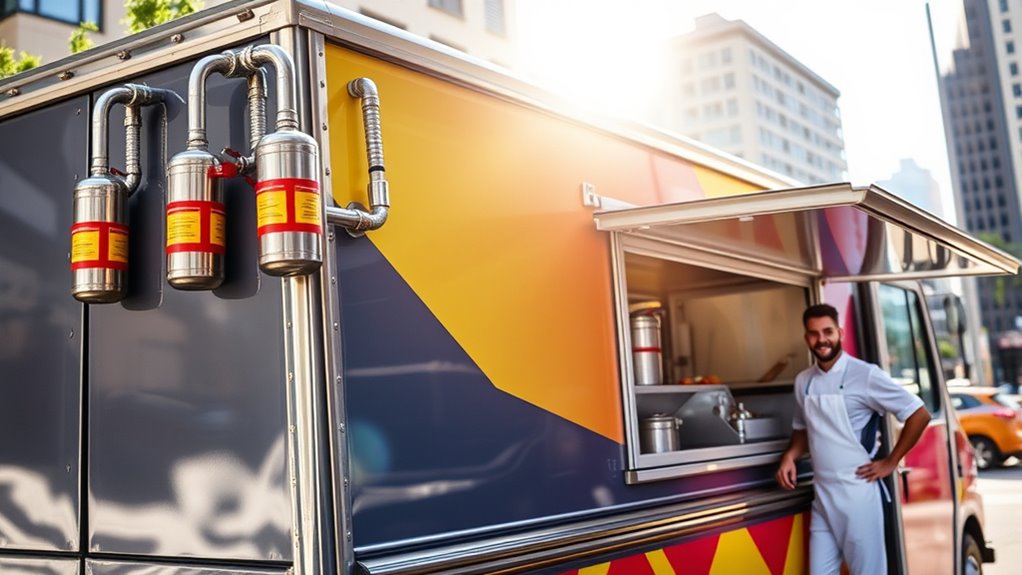

Choosing fire suppression for a food truck is not the same as outfitting a home kitchen: a compact vehicle combines hot cooking equipment, grease-laden exhaust, limited space, and a need for accessible emergency controls. My strongest match here is the HOODMART 5 ft. Concession Trailer Hood System, because it combines a commercial hood and ventilation components with an included Kidde suppression system. For a kitchen-focused backup extinguisher, I’d look at the Strike First SF-6LK; it is a purpose-built wet-chemical unit for cooking-fat fires, although its 22-pound weight makes mounting and access part of the decision. The four-pack of compact extinguishers is easier to distribute around a vehicle, but it is not a substitute for a properly designed and installed hood system.

Get baking supplies delivered free with Prime
- Fast, free delivery on millions of items
- Prime Video, Amazon Music and more included
- Member-only deals all year
The main tradeoff is between a built-in cooking-line system and standalone equipment that offers limited, supplementary protection. I also include an automatic residential device and a motorsports system to make their fit clear: neither should be assumed suitable for a commercial food-truck kitchen. Product listings alone cannot establish that a system meets your local fire-code requirements, fits your appliances, or is properly installed. I’d confirm those details with the fire marshal and a qualified fire-protection contractor before buying.
Complete the kit


Key Takeaways
- Best direct food-truck match: The HOODMART package combines a trailer-mounted hood, exhaust components, and an included Kidde suppression system; verify system details and local approval before installation.
- Best standalone kitchen extinguisher: The Strike First SF-6LK uses wet chemical for cooking-fat fires and offers a 73-second discharge, but it weighs 22 pounds.
- Best supplementary set: The four-pack supplies compact ABC and K-class extinguishers with wall mounts, but their small size and limited range do not replace a hood system.
- Not a commercial kitchen substitute: Haven is an automatic, heat-activated residential device, while the Lifeline Zero 2020 is designed for motorsports.
- Fit and approval come first: Confirm hood dimensions, suppression coverage, installation requirements, service needs, and local fire-code acceptance before selecting equipment.
| HOODMART 5 ft. Concession Trailer Hood System with Fire Suppression |  | Best Overall for a Food-Truck Kitchen | Model: EXSS005CB-FIRE | Hood dimensions: 5 ft. × 30 in. | Material: 18-gauge stainless steel | VIEW ON AMAZON | See Our Full Breakdown |
| Strike First SF-6LK 6 Liter Wet Chemical Class A K Fire Extinguisher |  | Best Standalone Kitchen Extinguisher | Capacity: 6 liters | Fire classes: Class A and K | Agent type: Wet chemical | VIEW ON AMAZON | See Our Full Breakdown |
| 4-Pack Home Fire Extinguisher with Wall Mount, Portable ABC & K Class |  | Best for Distributed Supplementary Coverage | Package quantity: 4 extinguishers | Weight: 1.37 lb each | Listed fire classes: A, B, C, and K | VIEW ON AMAZON | See Our Full Breakdown |
| Haven Automatic Heat-Activated Fire Suppression Device 135°F |  | Best Automatic Residential Device, Not for Commercial Kitchen Protection | Activation temperature: 135°F (57°C) | Stated coverage: At least 100 sq. ft. | Installation: Cut a 5 3/4 in. hole; device slides into place | VIEW ON AMAZON | See Our Full Breakdown |
| Lifeline Racing Fire System Zero 2020 |  | Not Recommended for Food Trucks | Model: Lifeline Zero 2020 | Weight: 12 lb | Height: 13.5 in. | VIEW ON AMAZON | See Our Full Breakdown |
| firesuppression system for food truck | Weight |
|---|---|
| HOODMART 5 ft. Concession Trai | — |
| Strike First SF-6LK 6 Liter We | 22 lb |
| 4-Pack Home Fire Extinguisher | 1.37 lb each |
| Haven Automatic Heat-Activated | — |
| Lifeline Racing Fire System Ze | 12 lb |
More Details on Our Top Picks
HOODMART 5 ft. Concession Trailer Hood System with Fire Suppression
This is the only option in the lineup presented as a food-truck and concession-trailer hood package rather than an extinguisher or an unrelated suppression device. Its 5-foot stainless-steel hood comes with an exhaust fan, baffle filters, grease cups, lights, mounting hardware, and a Kidde fire suppression system. For a truck operator planning a new or replacement cooking-line installation, that coordinated scope is the clearest reason to put it first: the hood and exhaust address grease-laden vapors while the included suppression system is intended to protect the cooking area.
Compared with the Strike First SF-6LK, this package aims at a built-in kitchen installation instead of relying on a person to grab and operate a portable extinguisher. Compared with the four-pack, it is much more specifically targeted to a trailer kitchen, though also less flexible and more involved to fit. Its ducted ventilation requirement means the truck needs a compatible exhaust path, and a five-foot hood may not suit every appliance layout. The listing does not specify suppression-agent type, nozzle arrangement, appliance coverage, inspection schedule, or the precise approvals for a given jurisdiction. I would treat those as pre-purchase questions, not assume the included system automatically satisfies the local fire marshal.
Its NSF and UL listing claims, welded 18-gauge steel construction, and two-year warranty make it a more purpose-built choice than the other products here. Still, installation and commissioning matter as much as the hardware. I’d ask a qualified contractor to confirm hood dimensions, duct routing, suppression coverage, compatible appliances, service access, and required permits before ordering. This is the strongest match in this roundup, but it is not a plug-and-play guarantee of compliance.
Pros:- Designed specifically for food trucks and concession trailers.
- Includes a Kidde fire suppression system with hood and ventilation components.
- Baffle filters, grease cups, fan, lighting, and mounting hardware are part of the package.
- Stainless-steel construction with stated NSF and UL approvals and a two-year warranty.
Cons:- Requires ducted ventilation and a suitable installation location.
- The listing does not spell out agent, nozzle coverage, or local approval for a specific truck.
- A fixed 5-foot hood may not match every kitchen layout.
Best for: Food-truck operators fitting a compatible 5-foot cooking line who want a hood, ventilation components, and an included suppression system in one package.
Not ideal for: Trucks without a ducted exhaust route, kitchens whose appliance layout exceeds or differs from the hood dimensions, or buyers who need confirmed local-code approval before a contractor review.
- Model:EXSS005CB-FIRE
- Hood dimensions:5 ft. × 30 in.
- Material:18-gauge stainless steel
- Ventilation:Ducted/vented; exhaust fan with variable speed control
- Filters:Baffle grease filters
- Included suppression:Kidde fire suppression system
- Listed approvals:NSF and UL
- Warranty:2 years
Our verdict“I rank this first for food-truck fire suppression because it is the only kitchen-and-trailer package here that includes both a hood system and suppression hardware, subject to professional fit and code checks.”
Strike First SF-6LK 6 Liter Wet Chemical Class A K Fire Extinguisher
When a buyer needs a portable extinguisher described for kitchen fires, the Strike First is the most specialized choice here. Its 6-liter wet-chemical charge is specified for Class A and K fires, and the 73-second discharge gives an operator more time to apply agent than the compact four-pack appears to offer. That distinction matters in a food truck: a small unit may be easier to mount, but a longer discharge and kitchen-focused agent are more relevant to cooking-fat hazards.
The tradeoff is its 22-pound weight and commercial-kitchen scope. A heavy extinguisher needs a secure, accessible mounting location, and staff should know how to reach and operate it without blocking an exit or interrupting access to other equipment. Unlike HOODMART’s integrated package, this is not a hood, ventilation system, or automatic cooking-line system; it remains a manually operated extinguisher. Its listed certifications are useful product information, but they do not establish that it satisfies every local food-truck requirement or replaces a required fixed system.
I’d choose it as a kitchen-oriented portable option after a fire-protection professional confirms the right placement and local requirements. Compared with the four-pack, it is heavier and less convenient to distribute around the vehicle, but its stated wet-chemical application makes its role clearer. Compared with the HOODMART package, it costs the buyer none of the hood’s installation scope—but it also does not provide that scope. This makes it a stronger supplementary pick than an all-in-one answer for a commercial truck.
Pros:- Wet-chemical agent and Class K designation suit the stated kitchen-fire role.
- 6-liter capacity with a listed 73-second discharge time.
- Stainless-steel construction.
- The listing provides several UL, ULC, NFPA, ANSI, and DOT references.
Cons:- At 22 pounds, it may be cumbersome for some staff to carry or handle.
- A portable extinguisher does not provide the hood and ventilation scope of the HOODMART package.
- Product details alone do not confirm local food-truck acceptance or placement requirements.
Best for: Operators seeking a larger, wet-chemical portable extinguisher for a commercial kitchen area and able to mount and access a 22-pound unit.
Not ideal for: Anyone looking for a complete hood suppression installation, a lightweight extinguisher, or confirmation of food-truck compliance from the product listing alone.
- Capacity:6 liters
- Fire classes:Class A and K
- Agent type:Wet chemical
- Discharge time:73 seconds
- Weight:22 lb
- Dimensions:21.5 in. H × 8.75 in. W × 7.13 in. diameter
- Material:Stainless steel
- Operating pressure:100 psi
- Listed certifications:UL/ULC, NFPA 10, ANSI/UL 8 & 711, CAN/ULC-S508/S554, DOT
Our verdict“I’d pick the Strike First as the clearest kitchen-focused portable option here, but only as part of a professionally planned food-truck fire-safety setup.”
4-Pack Home Fire Extinguisher with Wall Mount, Portable ABC & K Class
The practical appeal of this set is four compact extinguishers with wall mounts, making it easier to place portable units where crew members can reach them. The product description lists A, B, C, and K fire classes, which gives it a broader stated range than a unit limited to kitchen fires. Each extinguisher weighs 1.37 pounds and has a spray range of up to 13 feet, so handling and access may be less demanding than with the 22-pound Strike First.
That portability is also the main limitation. A small, lightweight canister is not equivalent to the Strike First’s 6-liter wet-chemical unit, nor to the hood-mounted suppression package from HOODMART. The provided information does not give the agent formulation, discharge duration, or a capacity measure that would show how much fire it can handle. Although the description includes K-class capability, I would confirm the label, listing, and suitability with a fire-protection professional before relying on it around commercial cooking equipment.
I see this set as an add-on for accessible portable coverage, not the core fire-suppression system for a food truck. Its four-unit format may help distribute equipment across a vehicle, but mounting locations should be selected so units remain visible and reachable without obstructing movement. The units are disposable after use, so an activation means replacement rather than refilling. Compared with the more specialized Strike First, this is easier to spread around but offers less evidence of sustained kitchen-fire capacity. Compared with HOODMART, it lacks the hood and fixed suppression components.
Pros:- Four extinguishers allow multiple mounting locations.
- Each unit weighs 1.37 pounds and includes a wall mount.
- The description lists A, B, C, and K fire classes.
- Portable format may be easier to access than a heavy standalone unit.
Cons:- Small size may limit suppression capacity for a larger fire.
- The listed spray range is up to 13 feet, and the units are disposable after use.
- The provided specifications do not state discharge duration or detailed agent information.
Best for: Food-truck owners looking for several lightweight, wall-mounted portable units as supplementary equipment after confirming their suitability and placement.
Not ideal for: Buyers who need a primary commercial-kitchen suppression system, a larger-capacity extinguisher, or product documentation that clearly establishes commercial food-truck approval.
- Package quantity:4 extinguishers
- Weight:1.37 lb each
- Listed fire classes:A, B, C, and K
- Spray range:Up to 13 ft.
- Temperature tolerance:−4°F (−20°C)
- Mounting:Wall mount included
- Reuse:Disposable after use
- Stated environments:Home, vehicle, boat, and outdoor use
Our verdict“I’d use this four-pack only as supplementary portable coverage, since its ease of placement does not make it a replacement for a kitchen hood system or a larger wet-chemical extinguisher.”
Haven Automatic Heat-Activated Fire Suppression Device 135°F
Haven’s appeal is its automatic heat activation: the device is described as activating at 135°F and providing ABC dry-chemical suppression for residential and outbuilding settings. The listing says it covers at least 100 square feet and can be installed without plumbing or wiring. That can make it sound simpler than a hood system, but the stated application is not a commercial food-truck cooking line, and I would not infer kitchen-system approval from the temperature trigger or area figure.
Compared with the Strike First, Haven is automatic rather than manually operated, but it does not provide the same stated wet-chemical kitchen focus. Compared with the HOODMART package, it is a small standalone device without the hood, grease filters, or exhaust components that define a cooking-line installation. The heat trigger is not smoke detection, according to the product information, and testing involves battery replacement. The listing also cautions against use where people are immobile or incapacitated, a limitation that makes placement and occupancy important.
I include it to show why an easy-to-install automatic device should not be confused with a food-truck fire suppression system. Its residential and outbuilding description, ABC dry-chemical agent, and activation method leave important unanswered questions for a mobile commercial kitchen. A buyer considering any automatic device in a truck should ask the authority having jurisdiction and a qualified contractor whether it is permitted for the intended area, compatible with equipment, and suitable for the risk. Against the compact four-pack, it adds automatic activation but loses flexibility in placement and does not provide multiple portable units.
Pros:- Heat-activated operation is described for fires reaching 135°F.
- The listing states at least 100 square feet of coverage.
- Installation is described as requiring no plumbing or wiring.
- The stated protection duration is up to five years.
Cons:- Designed for residential and outbuilding settings, not specifically for food trucks.
- Heat activation does not provide smoke detection.
- The listing cautions against use around immobile or incapacitated persons and notes battery testing needs.
Best for: A buyer seeking a heat-activated device for an eligible residential or outbuilding space, not as the main protection for a food-truck cooking line.
Not ideal for: Food-truck operators needing a code-accepted commercial kitchen or hood suppression system, smoke detection, or protection in spaces with immobile occupants.
- Activation temperature:135°F (57°C)
- Stated coverage:At least 100 sq. ft.
- Installation:Cut a 5 3/4 in. hole; device slides into place
- Protection duration:Up to 5 years
- Agent type:ABC dry chemical
- Activation:Heat-activated; not smoke detection
- Maintenance note:Battery replacement required for testing
- Stated application:Residential and outbuilding settings
Our verdict“I would not select Haven as a food-truck kitchen system; its automatic residential role is distinct from the trailer hood and kitchen-focused extinguisher options.”
Lifeline Racing Fire System Zero 2020
The Lifeline Zero 2020 is the clearest mismatch in this roundup. Its five-nozzle AFFF system is designed for motorsports, with three nozzles for an engine bay and two for a cockpit. Those locations and the vehicle hazards they address are different from a food truck’s cooking appliances and grease-laden hood. A compact 12-pound cylinder and included mounting hardware may look adaptable, but the stated application does not establish that it is suitable for kitchen fires or commercial food-service requirements.
Compared with the HOODMART system, Lifeline lacks a food-truck hood and ventilation package and is not described as a cooking-line system. Compared with Strike First, it does not have a listed Class K rating or wet-chemical kitchen agent. Its multiple nozzles are useful within its motorsports role, but nozzle count alone does not prove coverage for fryers, grills, or cooking surfaces. I would not repurpose it for food-truck suppression without explicit written approval from the manufacturer and the local fire authority.
This product may make sense to someone outfitting a race car according to applicable motorsports guidance, but that is a separate buying decision. The listing also notes it cannot ship to freight-forward companies in Florida, which may affect fulfillment for some buyers. I rank it last because it is the least aligned with the requested food-truck use, not because compactness or multiple outlets are inherently poor features. In this lineup, the more appropriate path is the trailer-specific HOODMART package or a kitchen-rated portable extinguisher selected with professional guidance.
Pros:- Compact 12-pound system with mounting brackets and pull cables.
- Five nozzles are allocated to engine-bay and cockpit areas.
- The listed AFFF foam is described for rapid heat absorption.
- Tubing and installation components are included.
Cons:- Designed for motorsports rather than food-truck kitchens.
- The supplied details do not establish Class K or cooking-line suitability.
- The listing notes a freight-forwarding restriction for Florida.
Best for: Motorsports buyers seeking a compact system specified for engine-bay and cockpit coverage.
Not ideal for: Food-truck operators seeking protection for fryers, grills, cooking surfaces, or a commercial kitchen hood.
- Model:Lifeline Zero 2020
- Weight:12 lb
- Height:13.5 in.
- Diameter:6 in.
- Agent:AFFF foam
- Nozzles:5 total: 3 engine bay, 2 cockpit
- Included hardware:Pull cables, mounting brackets, and tubing
- Stated application:Motorsports
Our verdict“I would skip the Lifeline for food-truck fire suppression because its stated motorsports coverage does not match commercial cooking hazards.”

How We Picked
I ranked these five products by how directly their stated design and supplied components address fire suppression in a food truck. The most relevant option is not simply the one that can put out some type of fire; it is the one that appears designed for cooking equipment and a trailer kitchen, with the right system scope for that setting. I gave the HOODMART package the top position because its listed components include a concession-trailer hood and a Kidde fire suppression system, alongside ventilation and grease filters. That makes it the most complete food-truck-oriented package in this lineup, though the listing does not provide enough information to confirm the suppression agent, coverage layout, installation plan, or acceptance by any particular authority.
Next, I considered whether standalone extinguishers are described for commercial kitchen hazards. The Strike First unit ranks ahead of the compact four-pack for that role because it is a 6-liter wet-chemical extinguisher specified for Class A and K fires and has a long listed discharge time. The four-pack offers multiple mounting points and includes K-class capability in its description, but each extinguisher is small, and the data does not establish that one can cover a commercial cooking line. I treat both as possible supplementary equipment rather than as interchangeable alternatives to an installed hood suppression system.
The remaining products rank lower because their stated applications do not establish food-truck kitchen suitability. Haven is described for residential and outbuilding spaces and activates by heat; its listing does not show commercial cooking-line coverage. Lifeline is expressly a motorsports system with engine-bay and cockpit nozzles, not a kitchen system. I include them to distinguish relevant choices from tempting but mismatched products. Across all five, I weighed application fit, fire-agent or system information, installation implications, access, and practical limitations. Product information is not a substitute for a site assessment, code review, or guidance from a qualified fire-protection professional.
Factors to Consider When Choosing Firesuppression System For Food Trucks
I would start with the truck’s cooking equipment and installation constraints, not with a claim that a product is universally suitable. A food truck’s suppression setup needs to match its appliances, hood, exhaust, fuel and electrical arrangements, and local requirements. The products in this comparison span a trailer hood package, kitchen-focused portable equipment, and options aimed at residential or motorsports use. Those categories are not interchangeable.
Separate a hood system from a portable extinguisher
A hood-mounted suppression system is intended to address hazards around a cooking line as part of a larger kitchen installation. A portable extinguisher is manually carried and operated. The HOODMART package is the only product here that combines a trailer hood with an included suppression system, fan, filters, and related hardware. The Strike First is instead a standalone wet-chemical extinguisher. The four-pack provides several small portable units. I would not treat either portable option as an automatic substitute for a fixed system where one is required.
Ask your fire marshal or other authority having jurisdiction what the truck requires. Have an experienced fire-protection contractor review your actual appliance lineup and hood layout. Don’t assume a product title, agent label, or general certification statement settles whether it is accepted for your specific vehicle and use.
Match the stated agent and fire class to the hazard
Product descriptions and markings matter. Strike First lists a wet-chemical agent and Class K, making its stated purpose more directly connected to commercial cooking-fat fires than the motorsports Lifeline system or Haven’s residential ABC dry chemical. The four-pack description also lists K-class capability, but its compact size and missing discharge-time details call for extra scrutiny. I would check the extinguisher label, manufacturer documentation, and professional advice rather than infer effectiveness from a broad class list alone.
Do not select an extinguisher based only on convenience or the number of units in a package. Confirm that the actual product is appropriate for the relevant equipment and that crew members can access and use it. An extinguisher that is hard to reach, poorly mounted, or not suited to the hazard may fail to meet the purpose it was purchased for.
Check dimensions, ducting, and service access
The HOODMART hood is listed at 5 ft. by 30 in. and requires ducted ventilation. Before ordering, compare those measurements with the cooking line, ceiling height, trailer structure, and planned exhaust route. A hood that does not cover the intended appliances or cannot be properly ducted is not a good fit just because its listing mentions a fire suppression system.
Ask who will install and commission the system, how the suppression components will be inspected or serviced, and whether the package needs additional parts for your truck. The product description does not provide every detail needed to plan a finished installation. A qualified contractor can identify gaps before the truck is modified, rather than after equipment has been mounted.
Plan for access, training, and maintenance
Portable equipment should be mounted where trained staff can reach it quickly without blocking exits, controls, or the normal work path. The Strike First’s 22-pound weight is a meaningful handling factor; its listed 73-second discharge is useful information, but it does not remove the need for suitable placement and training. The four-pack weighs less per unit, but its limited size and disposable-after-use status affect how operators should plan for replacement.
For an automatic device such as Haven, understand what triggers it, what the listing says it detects, how it is tested, and when it needs attention. Haven’s description says it responds to heat, not smoke, and notes battery replacement for testing. A buyer should keep manufacturer instructions and required service records available and follow the schedule set by the equipment maker and local authorities.
Treat application claims as a starting point, not approval
HOODMART is the strongest application match in this lineup, but its supplied details do not establish agent chemistry, nozzle arrangement, coverage calculations, or approval for every jurisdiction. Strike First lists several standards and certifications, yet that still does not decide where it must be mounted or whether a fixed system is required. The Haven and Lifeline descriptions are explicit about other settings, so I would not repurpose them as food-truck kitchen protection based on compactness or automatic operation.
Before purchase, send the product documentation and truck layout to the authority having jurisdiction or a qualified fire-protection contractor. Ask for confirmation on appliance coverage, hood and duct compatibility, required equipment, installation, inspection, and any local rules. That step is especially important for a mobile kitchen, where vehicle dimensions and local operating requirements can vary.
Frequently Asked Questions
Which product in this comparison is the closest fit for a food-truck fire suppression system?
The HOODMART 5 ft. Concession Trailer Hood System is the closest fit because it is described for food trucks and concession trailers and includes a Kidde fire suppression system alongside a hood and ventilation components. The listing does not establish that it suits every appliance layout or local code. I would have a qualified contractor and the local authority confirm coverage, installation, and approval before purchase.
Can a portable extinguisher replace a hood-mounted suppression system?
I would not assume so. A portable extinguisher is manually operated and offers a different type of coverage from a fixed cooking-line system. The Strike First and four-pack units may have supplementary roles if their labels and placement suit the truck, but product descriptions alone cannot establish that they replace a system required by local rules. Ask the authority having jurisdiction what your operation needs.
Is the Strike First SF-6LK a better choice than the four-pack?
It depends on the role. Strike First is the more clearly specified standalone kitchen option here, with a 6-liter wet-chemical charge, a Class K designation, and a 73-second listed discharge. The four-pack offers four lighter units and more possible mounting locations, but each is small and the supplied data gives less detail about capacity and discharge time. Neither product is a complete hood installation.
Should I use the Haven automatic device or Lifeline system in a food truck?
I would not choose either as the main food-truck cooking-line system based on the supplied information. Haven is described for residential and outbuilding settings and activates by heat; Lifeline is designed for motorsports engine-bay and cockpit coverage. Their stated applications do not establish suitability for commercial cooking equipment. A fire-protection contractor or local authority can advise whether either has any permitted secondary role.
What should I verify before buying a hood suppression package?
Confirm the hood dimensions and duct route against your actual kitchen, then ask a qualified contractor to verify appliance coverage, suppression components, installation and commissioning needs, maintenance access, and required inspections. Share the product documentation and truck layout with the local authority having jurisdiction so you can confirm applicable approval requirements. The HOODMART listing is a strong starting point for a trailer kitchen, not a guarantee that the package meets every local rule as configured.
Conclusion
For an operator building or refitting a compatible trailer kitchen, I’d start with the HOODMART hood-and-suppression package because it is the only option here designed around food-truck ventilation and an included fixed suppression system. I would make that recommendation conditional on a contractor confirming the hood fit, ducting, coverage, and local approval. If you need a kitchen-focused portable extinguisher to supplement an appropriate system, the Strike First SF-6LK is the most clearly specified choice, provided its weight and mounting position work for your crew. The four-pack makes more sense when you want several compact, accessible units and have verified their suitability for your operation.
I would skip Haven as the primary truck-kitchen solution because its stated role is residential and heat-activated, and I would skip Lifeline because it is designed for motorsports. For any buyer, the deciding step is not just choosing a product: it is confirming that the system matches the actual cooking line and is accepted, installed, and maintained according to local requirements.