For Thanksgiving dessert, the serving platter affects more than how pie looks on the table: it also determines how easily guests can serve themselves, how much cleanup falls to the host, and whether the serving pieces are useful after the holiday. The practical comparison is between reusable ceramic platters and disposable serving trays. Ceramic is the stronger choice for an intentional table and repeated use; disposable trays make more sense when cleanup, transport, or serving a crowd matters most. The right choice depends on whether you value a lasting presentation or a lighter end to a long meal.

Get baking supplies delivered free with Prime
- Fast, free delivery on millions of items
- Prime Video, Amazon Music and more included
- Member-only deals all year
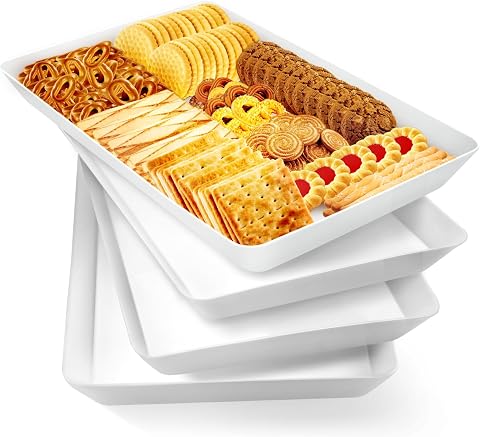
WOWBOX 4-Pack Rectangular Serving Trays
- ✔ Material: Plastic
- ✔ Color: White
- ✔ Shape: Rectangular

Lifewit Set of 4 Reusable Plastic Serving Trays
- ✔ Material: Food-grade plastic
- ✔ Color: White
- ✔ Shape: Rectangular

R-kay Gold Plastic Serving Trays, 8 x 11 Inches, 3-Pack
- ✔ Material: Plastic
- ✔ Color: Gold
- ✔ Shape: Rectangular
At a Glance
| Criteria | Reusable ceramic serving platters | Disposable serving trays | Winner |
|---|---|---|---|
| Presentation | Polished, substantial look; suits a coordinated table | Functional look; decorative styles are available | A |
| Durability | Sturdy, but can chip or break if dropped | Lightweight, but may bend or sag under heavy desserts | A |
| Cleanup | Requires washing and drying | Can usually be discarded after use | B |
| Capacity and variety | Wide range of shapes and sizes; heavier when loaded | Easy to add several trays for a large spread | Depends |
| Transport | Heavy and needs careful handling | Light and convenient for potlucks | B |
| Storage and reuse | Reusable, but takes cabinet space | Little storage needed; generally single-use | B |
| Overall value | Higher upfront cost can pay off over many occasions | Lower upfront cost, with recurring purchases for future events | Depends |
WOWBOX 4-Pack Rectangular Serving Trays
For a Thanksgiving table with several desserts to set out at once, the WOWBOX four-pack gives us the most adaptable starting point. Each tray measures 14 by 9.3 inches, and the set’s stackable shape helps it earn its place even when holiday serving pieces are only used occasionally. Compared with R-kay’s shorter 8 by 11 inch trays, WOWBOX provides more listed length and one extra tray, so it is easier to separate pie slices, cookies, and fruit without crowding everything together.The smooth, shatter-resistant plastic prioritizes low-fuss handling over a formal serving-dish look. That can be useful when guests are carrying plates around or when we want trays that can also organize kitchen items after the meal. The tradeoff is visible: white plastic will not have the heft or polished finish of ceramic, glass, or metal. Its stated 3 kg maximum capacity also makes it a poor choice for unusually heavy dishes. Compared with Lifewit, WOWBOX’s care instructions are simpler—wipe with a damp cloth—but they do not specify a dishwasher-safe finish. Choose it for flexible, stackable serving; skip it if your centerpiece needs to feel like a traditional heirloom platter.
Pros:
- Four trays give a multi-dessert spread room to separate items.
- 14 by 9.3 inch dimensions offer useful surface area for slices and cookies.
- Stackable design makes seasonal storage easier.
- Shatter-resistant plastic and a wipe-clean surface suit casual, repeated use.
Cons:
- White plastic has a simpler appearance than ceramic, glass, or metal.
- The stated 3 kg capacity limits use with heavy serving dishes.
Best for: Hosts serving multiple dessert types who want four larger, stackable trays for flexible holiday use.
Not ideal for: Shoppers seeking a formal ceramic or glass presentation, or a tray for heavy dishes beyond the listed capacity.
Bottom line: We’d choose WOWBOX for the most balanced mix of tray count, listed size, and compact storage for a varied Thanksgiving dessert table.
“We’d choose WOWBOX for the most balanced mix of tray count, listed size, and compact storage for a varied Thanksgiving dessert table.”
Lifewit Set of 4 Reusable Plastic Serving Trays
Raised edges are Lifewit’s practical advantage: they give cookies, dessert bars, and small fruit a little containment while we carry the tray from counter to table. That makes this set a better fit than the flat, simply described WOWBOX trays when keeping loose pieces together matters. Its dimensions, 13.5 by 9.5 inches, are close to WOWBOX’s, though slightly shorter and a little wider; the four-tray count keeps it competitive for serving several choices.Lifewit also specifies BPA-free, crack-resistant plastic, and its trays are lightweight and stackable. Those details suit a host who expects to bring them out repeatedly, but the care instructions require more attention: hand wash only, and the trays are intended for warm dishes below 70°C. That stated limit makes them unsuitable for hot baking pans or very warm dishes straight from the oven. Compared with R-kay, Lifewit’s white finish is more neutral and the set includes one extra tray, while R-kay offers the more festive gold accent and a disposal option. We’d pick Lifewit when containment and repeated use matter more than the quickest cleanup.
Pros:
- Raised edges help keep small desserts and fruit in place during carrying.
- Four lightweight trays stack for storage.
- BPA-free and crack-resistant construction is described for repeated use.
- Nearly matches the WOWBOX footprint while adding a slightly wider listed dimension.
Cons:
- Hand washing is required; the trays are not dishwasher safe.
- Serving temperature is limited to below 70°C.
Best for: Hosts who carry cookies, bars, or fruit and value raised edges and a reusable four-tray set.
Not ideal for: Anyone who wants dishwasher convenience or needs to place hot dishes directly on the trays.
Bottom line: Lifewit is the better fit than WOWBOX when raised edges matter more than wipe-only cleanup, provided the temperature limit works for your menu.
“Lifewit is the better fit than WOWBOX when raised edges matter more than wipe-only cleanup, provided the temperature limit works for your menu.”
R-kay Gold Plastic Serving Trays, 8 x 11 Inches, 3-Pack
When the table needs a little color, R-kay’s gold finish gives this set a clearer decorative role than the two white options. The 8 by 11 inch trays are compact enough for a small arrangement of desserts or appetizers, and their appearance can coordinate with a warm autumn table setting. Compared with WOWBOX and Lifewit, though, these trays have a smaller stated footprint and come in a three-pack, so they are less suited to hosts who want to divide a large dessert selection across several platters.R-kay is described as disposable or reusable, which offers cleanup flexibility: we can keep them for another gathering or discard them after use. The product details also describe the plastic as BPA-free and durable, but provide less information about care and storage than WOWBOX and Lifewit. Its stated maximum weight recommendation is 3 kg; as with the other plastic choices, we would avoid treating it as a rigid dish for a heavy centerpiece. Choose R-kay when a gold accent and a flexible cleanup plan matter most. If you prioritize tray count, stackable storage, or more generous dimensions, the white four-packs offer a more practical serving base.
Pros:
- Gold color adds a seasonal accent absent from the white sets.
- Three trays provide separate serving surfaces for a smaller spread.
- Described as disposable or reusable, giving cleanup flexibility.
- BPA-free plastic is described as suitable for serving food.
Cons:
- 8 by 11 inch dimensions are smaller than the listed WOWBOX and Lifewit footprints.
- Three trays provide less capacity than either four-piece set.
- Care and storage details are limited in the supplied specifications.
Best for: Hosts who want a gold-colored accent for a smaller dessert selection and the option to dispose of trays after serving.
Not ideal for: Large gatherings needing four or more platters, or shoppers looking for detailed care and storage guidance.
Bottom line: R-kay is the most decorative choice here, but its smaller three-tray set is best reserved for a compact spread where gold color matters.
“R-kay is the most decorative choice here, but its smaller three-tray set is best reserved for a compact spread where gold color matters.”
As an Amazon Associate we earn from qualifying purchases.
Key Differences
The largest difference is what happens after dessert is served. Ceramic platters ask the host to wash, dry, and store them, but they can serve for many holidays and everyday meals. Disposable trays reduce the dishes left behind and are easier to carry, though flimsy ones may need support and are less suited to a carefully styled table. For a home-hosted dinner where the platters will be used again, ceramic offers the better long-term experience. For a potluck or a gathering where the host is short on cleanup time, disposable trays solve a real practical problem.
Capacity is less about the material than the specific platter. A large ceramic platter can hold a pie or an assortment of cookies securely, but it is heavy and occupies more room. Disposable trays are easy to set out in multiples, which can help separate pies, bars, and nut-free or gluten-free choices. They can also be easier to transport, provided the tray is sturdy enough for the food. Think about the desserts and serving location before deciding: a dense pie needs a firm base, while cookies and brownies are forgiving on lighter trays.
Price should be judged across expected use, not just checkout cost. Disposable trays are usually cheaper for one event, while a ceramic set may be better value if it comes out for birthdays, winter holidays, or weekly meals. Paying more for ceramic is worthwhile when appearance and repeated use matter. It is harder to justify if the platters will be stored away after Thanksgiving or if the host’s priority is getting guests fed with minimal washing.
Detailed Comparison
Presentation (Reusable ceramic serving platters wins — moderate)
Ceramic wins by a moderate margin for a traditional Thanksgiving table. Its weight, finish, and variety of glazes make pies and pastries feel deliberately served, and matching pieces can tie together a table setting. Disposable trays can look festive, especially in seasonal colors or patterns, but many still read as practical catering ware. If desserts will be a focal point in family photos or a buffet display, ceramic is the safer choice; for a casual gathering, the visual gap matters less.
Durability (Reusable ceramic serving platters wins — moderate)
Ceramic wins for stability, with a moderate advantage when carrying dense desserts such as pumpkin pie or cheesecake. A solid platter is less likely to flex under the load, though a fall can chip or shatter it. Disposable trays weigh less, but thin material may bow or buckle, especially if a tray is held at one edge. Choose a firm disposable option or place it on a baking sheet for support if you need easy carrying without risking a weak base.
Cleanup (Disposable serving trays wins — major)
Disposable trays win by a major margin for cleanup. Once guests finish, the tray can generally go in the bin, subject to local recycling and waste rules. Ceramic needs washing and drying, and sticky fillings or frosting may take extra attention. For a host already juggling dishes, coffee, and leftovers, avoiding several platter washes can be meaningful. If the meal is small or cleanup is shared, ceramic’s extra washing may be a minor inconvenience instead.
Capacity and variety (minor difference)
This is a tie because dimensions and quantity matter more than material. Ceramic comes in many shapes, from long rectangular platters for bars to round plates for pies. Disposable trays are easy to buy in several sizes and set out as separate stations. Neither is automatically roomier. Measure the available table or buffet space, then match each dessert to a tray with enough margin for serving utensils and slices.
Transport (Disposable serving trays wins — moderate)
Disposable trays win by a moderate margin for taking dessert to another home. They are light and do not need to be returned, and losing one is less costly. Ceramic can travel safely if it has a fitted carrier or a stable box, but the extra weight and breakage risk complicate the trip. For a potluck, disposable is more convenient; for a nearby dinner where the platter itself is part of the host’s presentation, ceramic can still work.
Storage and reuse (moderate difference)
Disposable trays win on storage because they take little room before use and can be discarded afterward. Ceramic wins on reuse: a platter can return for other holidays and everyday serving. The better fit depends on cabinet space and habits. A host with limited storage may prefer disposable trays even if they are used only once, while someone who entertains often can justify reserving shelf space for a few versatile ceramic pieces.
Overall value (moderate difference)
Neither wins for every host. Disposable trays cost less upfront and deliver strong value for a single meal, a large crowd, or a one-way potluck. Ceramic can offer better value across repeated use, particularly when a few versatile platters replace repeated seasonal purchases. The difference is major only when the platter will see frequent use; for a one-off Thanksgiving, convenience and cleanup may matter more than cost over time.
Reusable ceramic serving platters: Pros and Cons
Pros:
- Creates a more polished dessert display
- Stable for heavy pies and cakes
- Reusable for other holidays and everyday meals
- Available in many shapes, finishes, and sizes
Cons:
- Requires washing and drying
- Can chip or break if dropped
- Heavier and more awkward to transport
- Needs cabinet space between occasions
Disposable serving trays: Pros and Cons
Pros:
- Quick cleanup after serving
- Lightweight and convenient for potlucks
- Easy to set out several trays for different desserts
- Low upfront cost and little storage needed
Cons:
- May bend under heavy desserts
- Often looks less substantial on a formal table
- Usually needs to be repurchased for future gatherings
- Creates waste, depending on material and local disposal options
Who Should Choose What
Choose Reusable ceramic serving platters if:
- You are hosting at home and want dessert to feel part of a coordinated Thanksgiving table.
- You serve desserts throughout the year and will reuse the platters.
- You need a sturdy base for a dense pie or cake and can wash dishes afterward.
Choose Disposable serving trays if:
- You are taking dessert to a potluck and want a tray you do not need returned.
- You are serving a large group and want to divide desserts across several trays.
- Your main priority is reducing post-meal dishes or avoiding extra storage.
Skip both if: Choose lidded food storage containers for desserts that need protection during a longer trip; they are easier to transport securely than an uncovered platter or tray.
Value for Money
For one Thanksgiving, disposable trays are usually the lower-cost and lower-effort purchase. They are worth choosing when a tray needs to travel, when the gathering is large, or when washing extra serving pieces would add stress. Ceramic costs more at the outset, but paying extra makes sense for hosts who expect to use the platters repeatedly and value a more finished table. A small collection of versatile pieces can be better value than buying decorative disposable trays for every holiday. If reuse is unlikely, the ceramic premium is difficult to recover through use.
Final Verdict
Choose reusable ceramic platters for a home-hosted Thanksgiving where presentation, sturdy serving, and future use matter. Choose disposable trays for potlucks, crowded buffets, and gatherings where quick cleanup is the deciding factor. The biggest question is whether you will reuse the platter: frequent use makes ceramic the better value, while a single event favors disposable convenience. For most hosts who entertain more than once or twice a year, a few versatile ceramic platters are the stronger long-term buy; keep disposable trays for travel and overflow.
Frequently Asked Questions
Are ceramic platters better for serving Thanksgiving pie?
Usually, if the pie will be served at home. A sturdy ceramic platter provides a firm base and a polished presentation. For transport, its weight and breakage risk can be drawbacks, so use a secure carrier or choose a supported disposable tray.
Can disposable trays hold a heavy dessert?
Some can, but strength varies. Check the tray’s construction and support it from underneath when carrying a dense pie or cheesecake. A thin tray may flex even if it looks large enough.
Is it worth buying ceramic platters just for Thanksgiving?
Only if you expect to use them again. If the platters will serve birthdays, other holidays, or everyday meals, the higher upfront cost can pay off. For a one-time gathering, disposable trays are usually the more practical value.
Which option is easier for a Thanksgiving potluck?
Disposable trays are generally easier because they are light and do not need to be returned. If the dessert needs a lid or extra protection on the trip, use a lidded container and transfer it to a serving platter at the destination.