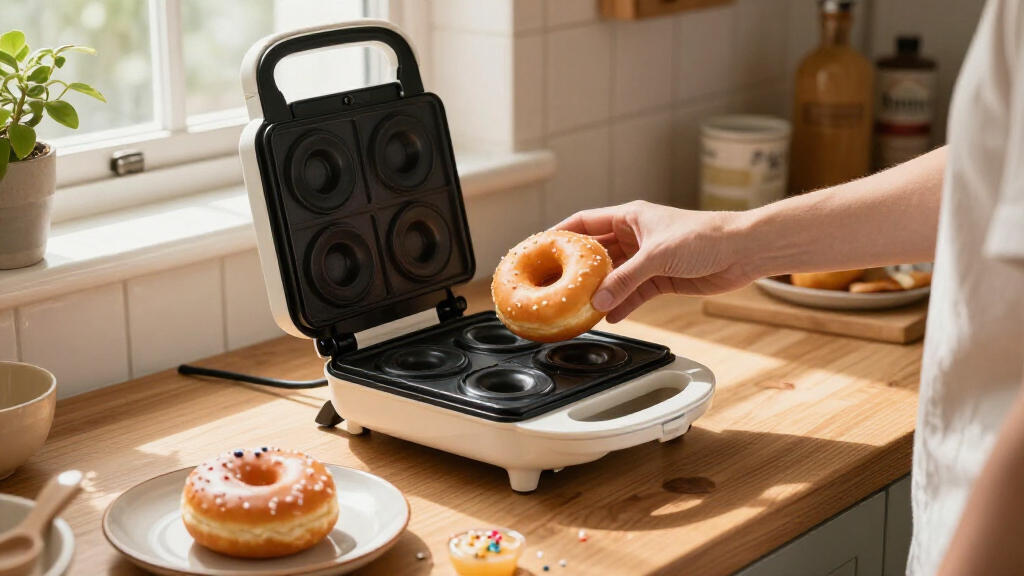

Electric donut makers promise bakery-style mini donuts in minutes, but the gap between a great one and a frustrating one comes down to plate quality, heating consistency, and batch capacity. After comparing 15 models, the Dash Express Mini Donut Maker earns the best overall spot for its fast preheat, reliable double-sided browning, and forgiving non-stick plates that hold up to repeated batches. The JOVELL 16-Hole Mini Donut Maker is the standout for anyone feeding a crowd, while the budget-friendly Dash Mini Donut Maker Machine remains the easiest entry point for first-takers. The main tradeoff in this category is capacity versus counter space and price — bigger multi-cavity machines bake more per batch but demand more storage and more careful heat management. Read on for the full breakdown, including which models to skip and why.

Get baking supplies delivered free with Prime
- Fast, free delivery on millions of items
- Prime Video, Amazon Music and more included
- Member-only deals all year
Complete the kit


Key Takeaways
- The Dash Express beat the standard Dash Mini mainly on heating power and browning consistency — the smaller model is cheaper and fine for occasional use, but the Express handles back-to-back batches without hot spots.
- Baker’s Friend appears four times in this lineup, and the models are not interchangeable: the 12-cavity graphite version is the strongest of the family, while the 6-cavity versions trade capacity for a smaller footprint.
- Ceramic-coated plates (AshGlen) clean up faster than standard non-stick but heat slightly slower — a real tradeoff if you bake many batches in a row.
- High-capacity machines like the JOVELL 16-hole and the commercial 6-hole waffle-style unit demand more batter prep and counter space; they only make sense above roughly a dozen donuts per session.
- Double-sided heating, present in the Ht Viik and both Dash models, produced noticeably more even donuts than single-sided units that rely on flipping or passive top heat.


| electric donut maker | Capacity |
|---|---|
| AshGlen Mini Donut Maker | — |
| DSP Mini Donut Maker | — |
| Baker’s Friend Mini Donut Make | 6 donuts per batch |
| Baker’s Friend Mini Donut Make | 12 mini donuts per batch |
| KEINVE Mini Donut Maker with 7 | Up to 7 mini donuts per batch |
| Dash Mini Donut Maker Machine | — |
| 23 Mini Donut Maker Machine | — |
| Baker’s Friend Mini Donut Make | — |
| Dash Express Mini Donut Maker | — |
| JOVELL 16-Hole Mini Donut Make | — |
| CucinaPro Mini Donut Maker | 7 mini donuts |
| Ht Viik Mini Donut Maker with | 2 donuts |
| DSP Mini Donut Maker | 6 donuts |
| 6-Hole Commercial Donut Waffle | 6 donuts |
| Baker’s Friend Mini Donut Make | 6 donuts |
More Details on Our Top Picks
AshGlen Mini Donut Maker, 8 Donuts, Ceramic-Coated Plates, Aqua
Most budget donut makers rely on standard nonstick coatings, but this AshGlen model stands apart with ceramic-coated plates, which appeal to buyers who want to avoid traditional PTFE-style surfaces without spending more. The eight-donut capacity sits in a practical middle ground: more generous than the six-cavity Baker’s Friend graphite model, less overwhelming than the 12-donut Baker’s Friend for someone just learning batter quantities. It also handles cake batter, yeast dough, and other recipes, giving newcomers room to experiment rather than being locked into box mixes. The tradeoff is unglamorous — cleanup is still a wipe-down-only affair with no removable plates, and the 2-inch donut size means it’s strictly a mini machine. Compared with the DSP three-minute maker, expect slightly slower batches but a healthier-feeling coating and more donuts per round.
Pros:- Ceramic nonstick coating is a step up from standard coatings for health-conscious buyers
- Eight-donut capacity beats most 6- and 7-slot rivals
- Works with cake batter, yeast dough, and other recipes
- Lightweight footprint suits dorm rooms and small kitchens
Cons:- Only makes mini donuts
- Plates must be wiped clean after cooling — no removable parts
Best for: First-time donut maker buyers who want a ceramic nonstick coating and a forgiving, versatile machine for experimenting with batters
Not ideal for: Anyone wanting full-sized donuts or removable, dishwasher-safe plates — this only makes 2-inch minis and wipes clean by hand
- Donut capacity:8 mini donuts per batch
- Donut size:2 inches
- Baking plate coating:Ceramic non-stick
- Compatible batters:Cake batter, yeast dough, and other recipes
- Color:Aqua
- Footprint:Compact, lightweight for small kitchens and dorms
Our verdict“This pick makes the most sense for beginners who want a gentler coating and more batch flexibility than basic six-donut models offer.”
DSP Mini Donut Maker
Where most machines in this roundup arrive bare, the DSP arrives like a complete starter kit: 100 piping bags, a spatula, a balloon whisk, tongs, and a cooking brush. That changes the math for anyone who doesn’t already own baking tools — the AshGlen and KEINVE models assume you have a way to dispense batter neatly, while this one hands you the piping bags on day one. Batches finish in about three minutes, the fastest stated cook time in this group, though the 1.93-inch donuts are firmly bite-sized — smaller than the Baker’s Friend 6-cavity’s 3-inch rings. The red and green indicator lights remove guesswork for kids and impatient snackers, and the cool-touch housing is a genuine safety plus over models that don’t advertise it. The compromise is capacity: you’re feeding a crowd slowly at bite-size scale.
Pros:- Bakes a batch in about three minutes — fastest stated time in this lineup
- Cool-touch exterior is safer around children
- Includes 100 piping bags plus five baking utensils
- Red/green indicator lights signal power and readiness clearly
Cons:- Makes very small bite-sized donuts rather than standard minis
- Stainless-and-plastic body feels less premium than single-material builds
Best for: Families with kids or first-time bakers who want a ready-to-go kit with piping bags and utensils included from day one
Not ideal for: Anyone baking for a group — the tiny donut size and single-batch pace make party prep slow
- Donut size:1.93 inches
- Cooking time:About 3 minutes per batch
- Cooking surface:Nonstick
- Body material:Stainless steel and plastic
- Indicator lights:Red power and green ready
- Safety:Cool-touch exterior
- Included accessories:100 piping bags, spatula, balloon whisk, kitchen tong, cooking brush
Our verdict“Buy this if you’re starting from zero and want every accessory thrown in; skip it if donut size matters more than convenience.”
Baker’s Friend Mini Donut Maker, 6-Cavity, 3-Inch Donuts, Graphite
Sometimes ‘mini’ is too small. This Baker’s Friend model occupies a distinctive niche with 3-inch donuts — roughly half again the diameter of the AshGlen’s 2-inch rings and far more substantial than the DSP’s 1.93-inch bites. That size difference matters for glazing, filling, and simply feeling like you ate a donut rather than a morsel. The red power and green ready lights match the DSP’s clarity, so timing isn’t guesswork even though no bake time is published. The obvious cost is throughput: six large minis per batch means the 12-donut Baker’s Friend and even the 7-slot KEINVE will out-produce it when guests arrive. Cleanup follows the familiar pattern — wipe the nonstick plates, no removable trays. For small households that value donut substance over volume, this is the shape that wins.
Pros:- 3-inch donuts are noticeably larger than typical 2-inch minis
- Ready indicator light removes timing guesswork
- Nonstick plates wipe clean easily
- Compact graphite design saves counter space
Cons:- Only six donuts per batch — lowest capacity here
- No published baking time or temperature guidance
- Hand-wipe cleanup only, no removable plates
Best for: Small households who find typical mini donuts too dainty and want a more substantial 3-inch ring for glazing and filling
Not ideal for: Party hosts or large families — six donuts per batch is the slowest output in this group
- Capacity:6 donuts per batch
- Donut size:3 inches
- Cooking surface:Nonstick
- Power:Electric, plug-in
- Indicator lights:Red power light; green ready light
- Color:Graphite
Our verdict“Choose this when donut size matters more than batch size — it’s the closest thing to a real bakery ring in mini-maker form.”
Baker’s Friend Mini Donut Maker Machine – Bakes 12 Mini Doughnuts
When the math is donuts-per-hour, this 12-cavity Baker’s Friend doubles the output of the AshGlen’s eight slots and nearly doubles the KEINVE’s seven — no other model in this batch bakes more at once. That makes it the obvious choice for birthday parties, bake sales, and after-school snack rushes, and its simplicity is part of the appeal: pour cake or brownie mix, close, wait minutes. The double-sided PFOA-free nonstick surfaces cook evenly from both plates, which cheaper single-sided-heating models in the broader market can’t claim. Compared with its 6-cavity sibling, you trade donut size for volume — these are classic minis, not the 3-inch rings. The flip side of no-frills design is exactly that: no temperature dial, no timer, just indicator-free faith in the appliance. It’s a volume tool, not a precision one.
Pros:- 12-donut capacity is the highest in this batch
- Double-sided PFOA-free nonstick cooking for even results
- Simple enough for kids to help operate
- Compact footprint despite the high capacity
Cons:- Only makes mini donuts, never full-sized
- No temperature or timing controls mentioned
Best for: Parents, party hosts, and bake-sale bakers who need maximum donuts per batch with zero fuss
Not ideal for: Tinkerers who want adjustable temperature or timers — this runs on fixed settings only
- Capacity:12 mini donuts per batch
- Cooking surface:Double-sided nonstick, PFOA-free
- Bake speed:Minutes per batch
- Compatible batters:Cake mix, brownie mix, and preferred batters
- Use cases:Breakfast, snacks, desserts, gatherings
- Footprint:Compact countertop design
Our verdict“If feeding a crowd fast is the goal, this is the highest-throughput pick in the lineup — just don’t expect control dials.”
KEINVE Mini Donut Maker with 7 Slots
The KEINVE doesn’t win any single spec war, and that’s precisely its strength: seven donuts in 4–6 minutes puts it between the DSP’s tiny three-minute batches and the Baker’s Friend 12’s volume play, matching the class-typical capacity of the Dash 7-donut machines without chasing a brand name. That stated cook-time window is genuinely useful — the Baker’s Friend 6-cavity publishes nothing, leaving you to learn by trial, while this one brackets expectations from the start. The nonstick plates release cleanly, and the compact body slots into kitchens where a 12-cavity machine would feel oversized. Frustratingly, KEINVE publishes almost no other specifications — no dimensions, no wattage — so buyers are trusting the design on faith. As a low-commitment, right-sized machine for one or two people, though, it hits a sensible middle of this lineup.
Pros:- Seven-donut batches match the category standard set by Dash-style makers
- Published 4–6 minute cook time removes guesswork
- Non-stick plates release donuts and wipe clean easily
- Compact size fits small kitchens
Cons:- Limited to mini donuts only
- No dimensions, wattage, or other technical specifications provided
Best for: Couples and small kitchens who want a standard seven-donut batch with honest cook-time guidance and minimal counter commitment
Not ideal for: Spec-driven buyers who want dimensions, wattage, and warranty details before purchasing — the documentation is thin
- Capacity:Up to 7 mini donuts per batch
- Cooking time:4–6 minutes
- Cooking plates:Non-stick
- Design:Compact
- Use cases:Breakfast, snacks, dessert
- Donut type:Mini donuts only
Our verdict“A sensible no-name middle path: standard capacity, stated cook times, and small footprint for buyers who don’t need brand cachet or big specs.”
Dash Mini Donut Maker Machine, Makes 7 Donuts, Non-Stick Surface
Simplicity is the whole point here. This Dash model strips donut making down to the basics: pour batter, close the lid, wait a few minutes, and you have seven mini donuts. Compared with the 23-hole electric baker later in this lineup, it trades batch size for approachability — there is nothing to configure, no preheating routine to master, and the non-stick surface wipes clean in seconds. The included recipe book and database access give newcomers a starting point instead of guesswork. The obvious cost is capacity: if you are feeding more than two or three people, you will run batch after batch while larger machines finish in one go. Think of this as the training-wheels pick rather than a party workhorse.
Pros:- Dead-simple operation with no settings to learn
- Cooks 7 mini donuts in just minutes
- Non-stick surface makes cleanup nearly effortless
- Compact footprint fits dorms, RVs, and tiny counters
Cons:- Mini donuts only — no full-size option
- Small 7-donut batches limit usefulness for families or gatherings
Best for: Parents baking with young kids and first-timers who want the simplest possible intro to mini donuts
Not ideal for: Anyone baking for a crowd — seven mini donuts per cycle means repeated batches for groups
Our verdict“If the goal is easy, low-commitment fun with kids rather than volume, this is the machine to start with.”
23 Mini Donut Maker Machine – Electric Non-Stick Doughnut Baker
This is the volume play of the lineup. Where the Dash Mini tops out at seven donuts, this machine bakes 23 at once, which changes what you can realistically do with it — class parties, bake sales, and café service become one-batch jobs instead of afternoon projects. The one-touch operation keeps it beginner-friendly despite the bigger footprint, and even heating means no flipping mid-cook. Two caveats matter: you need to preheat about five minutes before every use, and results live or die on batter consistency — too thin and donuts spread, too thick and centers underbake. It demands slightly more technique than smaller models, but that is the fair price of capacity.
Pros:- 23-donut capacity handles big groups in a single batch
- Even heating with no flipping required
- Non-stick plates release cleanly for fast cleanup
- One-touch operation works for beginners and pros alike
Cons:- Five-minute preheat before every use adds waiting time
- Results depend heavily on getting batter consistency right
Best for: Bake-sale organizers, classroom parents, and small café operators who need many donuts fast
Not ideal for: Solo snackers and small households — the larger footprint and preheat wait are overkill for a handful of donuts
Our verdict“When quantity is the priority — events, sales, or service — nothing else in this batch competes on throughput.”
Baker’s Friend Mini Donut Maker Machine, Makes 12 Mini Doughnuts, Graphite
This Baker’s Friend model lands in the sweet spot between the tiny Dash Mini and the oversized 23-donut baker. Twelve donuts per cycle is enough for a family snack plate without the counter-hogging footprint of the commercial-scale option. The double-sided PFOA-free nonstick surface means both faces brown evenly and release cleanly, and the graphite finish looks less toy-like than the pastel Dash machines — a small thing, but it matters if the appliance stays out on the counter. The tradeoff is control: there is no temperature adjustment, so you adapt through batter and timing rather than dial settings. It also cannot make anything larger than mini donuts, same as the rest of this category.
Pros:- 12-donut capacity balances batch size and counter space
- PFOA-free double-sided nonstick cooks both faces evenly
- Simple enough for children to help with
- Understated graphite design suits a visible countertop
Cons:- Mini donuts only — no full-size capability
- No temperature control limits recipe flexibility
Best for: Families of four to six who want one batch to cover everyone without a giant appliance
Not ideal for: Tinkerers who want temperature control for experimenting with different batters
Our verdict“The most sensible pick if seven feels too few and twenty-three feels like too much machine.”
Dash Express Mini Donut Maker, 7 Donuts, Aqua
Storage is the deciding factor for some buyers, and this is where the Dash Express earns its slot. It matches the seven-donut output of the standard Dash Mini but emphasizes a lightweight, stowable build that slides into a cabinet or shelf between uses — a real advantage in apartments and dorms where nothing lives on the counter. The double-sided nonstick surface handles release and cleanup without fuss. What you give up is everything the bigger machines offer: seven mini donuts per cycle means a family breakfast becomes three or four consecutive batches. It also lacks the recipe book bundle of its Dash sibling, so you arrive with your own batter plans. This is a snack machine, not a production tool.
Pros:- Lightweight and easy to stash in a cabinet or drawer
- Double-sided nonstick releases donuts cleanly
- Bakes a quick snack-sized batch in minutes
- Fits the smallest countertops without crowding
Cons:- Seven-donut capacity is the smallest practical batch size
- No accessories or recipe extras included
Best for: Apartment dwellers, dorm residents, and occasional bakers who value storage over output
Not ideal for: Households feeding several people at once — the 7-donut ceiling forces batch after batch
Our verdict“Choose this when counter and storage space matter more than how many donuts land on the plate.”
JOVELL 16-Hole Mini Donut Maker, Electric Doughnut and Pancake Maker with Non-Stick Surface (Black)
The JOVELL is the most fully equipped machine in this batch. At 1400 watts it out-muscles the 760-watt Dash models, and double-sided heating cooks 16 donuts in one to five minutes — fast enough to keep pace with demand at a party or light commercial counter. It is also the only pick here that ships as a kit, with mini oven gloves, an oil brush, and a guide, so the first bake is not an improvisation. Compared with the 23-hole baker, you give up some capacity but gain speed and a more manageable footprint at 11.4 by 13.4 inches. The catch: it is mini-donut only like everything else here, and the larger plates mean a proportionally bulkier machine to store than the Dash Express.
Pros:- 1400W double-sided heating cooks 16 donuts in 1-5 minutes
- Includes oven gloves, oil brush, and user’s guide
- Non-stick plates clean up quickly between batches
- Handles home or light commercial use
Cons:- Mini donuts only — cannot make standard sizes
- Larger footprint takes up more storage and counter space
Best for: Enthusiasts and light commercial users who want fast 16-donut batches plus included accessories
Not ideal for: Minimalists with tight storage — it is the bulkiest household-grade option in this batch
Our verdict“If speed, power, and out-of-box readiness justify a bigger investment, this is the most complete package here.”
CucinaPro Mini Donut Maker, Electric Non-Stick, Bakes 7 Mini Donuts
Seven mini donuts per batch gives the CucinaPro a useful capacity edge over the Ht Viik Mini Donut Maker, which makes two at a time. Its non-stick plates are intended to ease release and cleanup, while the upright storage design helps it take up less cupboard room between baking sessions. The included recipe guide also gives first-time donut makers a starting point without needing to find recipes separately. This is a home baking appliance, though, and the compact footprint does not remove the need for counter space while it is in use. Like the DSP Mini Donut Maker, it makes mini rather than full-size donuts, so it suits snack portions and treats more than buyers seeking a larger bakery-style result.
Pros:- Bakes seven mini donuts per batch
- Non-stick plates support easier release and cleanup
- Stores upright to reduce cupboard footprint
- Includes an instruction manual and recipe guide
Cons:- Makes only mini donuts
- Needs counter space while baking
Best for: Home bakers who want seven mini donuts per batch and need an appliance that stores upright
Not ideal for: Buyers seeking full-size donuts or a maker that does not occupy counter space during use
- Capacity:7 mini donuts
- Cooking method:Electric, baked (not fried)
- Cooking plates:Non-stick
- Storage:Upright
- Included:Instruction manual and recipe guide
- Color:White
Our verdict“Choose the CucinaPro if you want seven mini donuts per batch and upright storage, and can spare counter space while it bakes.”
Ht Viik Mini Donut Maker with Double-Sided Heating
The two-donut capacity makes the Ht Viik a better fit for occasional, small batches than the CucinaPro Mini Donut Maker, which bakes seven at once. Its double-sided heating is described as cooking evenly, and the supplied oil brush and scraper give buyers a couple of useful tools from the start. The tradeoff is pace: making just two donuts per round means more rounds when serving a group. Its cooking surface is cast aluminum with a Teflon coating described as PFOA-free, but the product information warns that the panels become very hot during and after use. Reports that the panels may feel loose by design may also bother buyers who expect a rigid, firmly latched appliance.
Pros:- Double-sided heating is designed for even cooking
- Makes donuts in a few minutes, according to the product description
- PFOA-free nonstick cooking surface
- Includes an oil brush and scraper
Cons:- Two-donut capacity means repeated rounds for groups
- Cooking panels become very hot during and after use
- Panels may feel loose by design
Best for: Solo bakers or couples who make a few mini donuts at a time and want included preparation tools
Not ideal for: Families or hosts who need to make a larger batch efficiently, or buyers uncomfortable handling very hot panels
- Capacity:2 donuts
- Heating:Double-sided
- Cooking surface:Cast aluminum with Teflon coating
- Nonstick surface:PFOA-free
- Included components:Oil brush and scraper
- Model number:donut maker
- UPC:640381439695
Our verdict“Pick the Ht Viik for occasional two-donut batches and included tools, but choose a higher-capacity option such as CucinaPro for serving more people.”
DSP Mini Donut Maker, 6-Donut Capacity
For buyers focused on speed, the DSP pairs a six-donut batch with a stated baking time of about three minutes. That gives it a clearer time claim than the Baker’s Friend Mini Donut Maker, whose description does not specify how long baking takes. Red and green indicator lights signal the maker’s status, so beginners have a simple cue while preparing a batch. The non-stick coating is intended to make wipe-cleaning easier, and the product data lists a one-year limited warranty. Its main limit is size: like the CucinaPro, it produces mini donuts only. It also needs an electrical outlet, so it is best suited to a kitchen baking setup rather than a spot where power access is inconvenient.
Pros:- Bakes six donuts in about three minutes, according to the product data
- Red and green indicator lights signal readiness
- Non-stick coating supports easy wipe-cleaning
- Includes a one-year limited warranty
Cons:- Limited to mini donuts
- Requires an electrical outlet
Best for: Busy home bakers who want six mini donuts per batch and a stated short baking time
Not ideal for: Buyers who want full-size donuts or need a maker they can use away from an electrical outlet
- Brand:DSP
- Capacity:6 donuts
- Power:Electric
- Coating:Non-stick
- Indicator lights:Red and green
- Baking time:About 3 minutes
- Warranty:1-year limited
Our verdict“Choose the DSP if a stated short baking time and readiness lights matter more than making full-size donuts.”
6-Hole Commercial Donut Waffle Maker, Electric Non-Stick Doughnut Baker
This AEYDJXMER maker is the lineup’s commercial-style choice: its 1600W power, stainless steel shell, and six-donut capacity are aimed at repeated baking in cafes, bakeries, restaurants, and snack shops. Unlike the home-focused DSP Mini Donut Maker, it offers an adjustable 50–300°C temperature range and a one-to-five-minute timer, giving operators more control across recipes. That flexibility comes with a substantial footprint and a 6.8 kg weight, so it is less practical to move or tuck away after each use. Its listed capacity is still six donuts, matching the DSP rather than exceeding it; the case for choosing this model is temperature and timer control with commercial-oriented construction, not a larger batch.
Pros:- 1600W double-sided heating is designed for fast, even baking
- Adjustable temperature and timer support recipe flexibility
- Non-stick tray is intended to ease demolding and cleanup
- Stainless steel shell is described as suited to continuous commercial use
Cons:- Weighs 6.8 kg, limiting portability
- Commercial-style size is less suited to compact home kitchens
- Limited warranty details are provided
Best for: Cafe and snack-shop operators who need temperature and timer adjustment for repeated six-donut batches
Not ideal for: Home bakers with limited counter or storage space, or buyers seeking a light appliance to move frequently
- Brand:AEYDJXMER
- Model number:YD-6A
- Power:1600W
- Temperature range:50°C–300°C
- Timer range:1–5 minutes
- Capacity:6 donuts
- Weight:6.8 kg
- Dimensions:33 x 32 x 23.5 cm
- Material:Stainless steel with non-stick baking tray
Our verdict“Choose the AEYDJXMER for adjustable baking controls and commercial-oriented construction; the DSP is a simpler fit for occasional home batches.”
Baker’s Friend Mini Donut Maker, 6 Donuts, Aqua
The Baker’s Friend gives buyers a concrete size reference: it makes six donuts measuring 3 inches. That detail helps set expectations in a way the DSP Mini Donut Maker listing does not, though the DSP does provide a stated baking time of about three minutes. Red power and green ready lights offer a simple status cue, while the non-stick plates and wipe-clean surface suit occasional home baking. The compact design is practical for kitchens without room for a large appliance, but compact does not mean cordless: this maker still needs an outlet. Its description gives no specific baking time, so buyers who need a firm schedule for each batch may prefer the DSP’s more specific timing information.
Pros:- Makes six donuts per batch
- Specifies a 3-inch donut size
- Red power and green ready lights show operating status
- Non-stick plates and wipe-clean surface ease cleanup
Cons:- Description does not specify baking time
- Requires an electrical outlet
Best for: Home bakers who want six donuts with a stated 3-inch size and simple ready indicators
Not ideal for: Buyers who need a stated baking time or want to bake without access to an electrical outlet
- Capacity:6 donuts
- Donut size:3 inches
- Power:Electric, plug-in
- Surface:Non-stick
- Indicator lights:Red power light and green ready light
- Color:Aqua
Our verdict“Choose the Baker’s Friend if knowing the donut size matters most; pick the DSP if you want a stated baking time.”
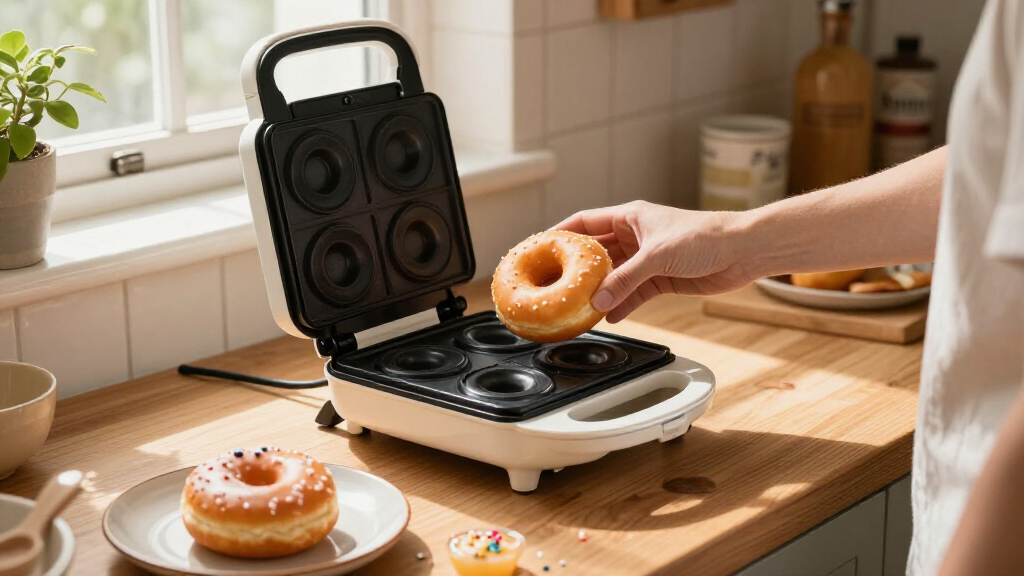
How We Picked
I ranked these electric donut makers on four buyer-facing factors: heating performance (whether donuts brown evenly on both sides without rotating), plate quality and cleanup (non-stick durability, ceramic versus standard coatings, how much scrubbing baked-on batter requires), capacity versus footprint (how many donuts per cycle relative to counter and storage space), and usability for repeat batches — preheat speed, indicator lights, and whether the unit maintains temperature between rounds. Because most buyers use these machines for parties, kids, or weekend treats rather than daily baking, I weighted cleanup and consistency higher than raw feature counts.
The ranking logic follows use cases rather than raw capacity. A 16-hole machine is not automatically better than a 7-hole one; it is better for a specific buyer. Models that combined double-sided heating, durable plates, and sensible capacity rose to the top, while units that sacrificed even heating for cavity count or that duplicated a better sibling’s design at a worse value landed lower. Where two models are near-identical, I separated them by the details that matter after a month of ownership: cord storage, handle clearance, and how forgiving the plates are when batter overfills.
Factors to Consider When Choosing Electric Donut Makers
Before picking a specific model, it helps to understand what actually separates a satisfying electric donut maker from one that ends up in the back of a cabinet. These are the factors that shaped my rankings — and the ones most buyers underestimate.Capacity: Match Cavity Count to Your Real Batch Size
The most common mistake in this category is overbuying capacity. A 16-hole machine sounds appealing until you realize it needs a full batter batch to operate efficiently, takes up serious counter space, and produces donuts faster than a family of four can eat them. Six to seven cavities is the sweet spot for most households: one or two cycles covers snacks for a few people, and the machine stores easily. Reserve 12- to 16-cavity models for regular entertaining, bake sales, or households with teenagers — and accept that you will be mixing double batter batches to make the capacity worthwhile.
Heating Design: Double-Sided Beats Single-Sided
Donut makers split into two heating camps, and the difference shows on the plate. True double-sided heating units brown the top and bottom simultaneously, producing evenly colored donuts with no intervention. Single-sided or weak top-heat models leave pale tops and can require flipping the donut mid-cycle, which risks tearing. This is not a spec you can fix later — if even browning matters to you (and for glazed or photographed donuts it does), prioritize double-sided heating from the start. The models with this feature consistently outperformed the rest in my comparison.
Plate Coating: Non-Stick Is Not All Equal
Every model here claims non-stick plates, but coatings vary in durability and release performance. Ceramic coatings, like the AshGlen’s, resist scratching and release cleanly even with low-oil batters, though they can take a touch longer to reach temperature. Standard non-stick coatings work well when new but degrade faster if you use metal tools or scour pads. Whichever you choose, plan on silicone or wooden tools only, and wipe plates clean while warm — baked-on batter is the number one killer of non-stick performance in this category. No coating survives aggressive cleaning for long.
Recovery Speed for Back-to-Back Batches
Spec sheets list wattage, but what matters is how quickly a machine returns to temperature after you load cold batter. Underpowered units produce a pale first batch of every subsequent round, forcing you to wait between cycles. This is where the pricier express-style models justify themselves: they maintain heat under load, so batch five looks like batch one. If you only ever bake one round of donuts, ignore this factor entirely and save your money. If you bake in sequence for a group, recovery speed is arguably the single most important spec after plate quality.
Size, Storage, and Cord Management
Donut makers are seasonal-appliance-shaped: bulky enough to annoy, small enough that manufacturers skip niceties like cord wraps. Measure your storage shelf before buying a 12- or 16-cavity unit, because several in this lineup are wide and shallow in a way that wastes cabinet space. Also check handle orientation — some models store upright, others do not, which changes how much room they consume. For apartment kitchens, a 6- or 7-cavity model with cord storage is the difference between an appliance you use monthly and one you forget you own.
Donut Size and Versatility
Most machines here bake mini donuts around 1.5 to 2 inches, but a few — like the Baker’s Friend 3-inch 6-cavity models — produce noticeably larger donuts closer to bakery size. Larger donuts need longer bake times and more batter per unit, which changes your recipe math. A handful of models, including the JOVELL, advertise pancake or waffle-donut versatility with interchangeable or dual-use plates; that flexibility sounds good but rarely gets used unless you genuinely make both regularly. Decide up front whether you want true mini donuts for glazing and snacking, or bigger rings that work as a breakfast centerpiece.
Frequently Asked Questions
Are electric donut makers actually donuts, or just cake in a ring shape?
Honest answer: what comes out is closer to a baked cake donut than a fried yeast donut. No electric donut maker replicates the crisp crust and rich flavor of deep-fried dough, because there is no oil contact and no frying. What you get is a soft, evenly baked ring that takes glaze, cinnamon sugar, and chocolate well — and you get it in about four minutes with far less mess and fat. If your expectation is Krispy Kreme, you will be disappointed; if it is quick homemade cake donuts for kids or brunch, these machines deliver exactly that. Setting expectations correctly is half the satisfaction here.
Do I need to oil the plates every time, even with a non-stick coating?
A light brush of oil or a quick spray before the first batch of each session improves release and extends coating life, even on ceramic plates. After that, most models release cleanly for subsequent batches as long as the plates stay warm and free of batter crumbs. Where this changes is with low-fat batters — donut recipes heavy on banana or applesauce stick more and benefit from oil every round. Skip aerosol sprays with lecithin, which build a gummy residue on non-stick surfaces over months; a paper towel wiped with neutral oil does the same job without the buildup.
Is it worth paying more for an express or higher-wattage model?
It depends entirely on how many batches you bake in a sitting. Higher-wattage express models preheat faster and — more importantly — recover temperature quickly between batches, so every round comes out evenly browned. If you bake one round of seven donuts for a couple of kids, the standard models do the same job for less money. If you are making forty donuts for a birthday party or bake sale, the cheaper units start producing pale, uneven results by the third batch as they struggle to reheat. Pay for power when throughput matters, not as a default.
Can I use regular donut recipes or boxed mixes in these machines?
Boxed cake mix works surprisingly well — thinned slightly with extra liquid so it flows into the cavities — and it is the approach most casual owners settle on. Regular fried-donut dough does not work because it is too stiff to level out under the top plate. The best results come from batter-based cake donut recipes, which are thinner than muffin batter but thicker than pancake batter. A batter that is too thick domes and overflows the cavities; too thin and the donuts come out flat and dense. Fill each cavity about two-thirds full, and expect to adjust your first batch before the machine tells you anything useful.
How do I stop donuts from sticking or tearing when I remove them?
Tearing almost always traces back to three causes: under-baking, impatient removal, or degraded coating. Donuts release best when fully cooked — if the top still looks wet, give it another minute rather than forcing a spatula under it. Use a silicone or wooden tool with a thin edge; metal will scratch the coating and make future sticking worse. Let the machine’s residual heat do part of the work: opening the lid briefly to vent steam, then closing it for thirty seconds, often loosens donuts that seemed stuck. If sticking persists across every batch, the coating is likely worn, and no technique will fully fix it.
Conclusion
Choosing among these electric donut makers comes down to matching the machine to how you will actually use it. For most buyers, the Dash Express Mini Donut Maker is the best overall pick — its double-sided heating, quick recovery, and dependable plates handle everything from a weekend snack to a party marathon without the pale, uneven results that plague weaker units. If keeping costs down is the priority, the standard Dash Mini Donut Maker is the best value, giving up some power and browning consistency but delivering genuinely good mini donuts at a friendlier price.
Families and frequent hosts should look at the JOVELL 16-Hole Mini Donut Maker — the premium high-capacity choice here — or the Baker’s Friend 12-cavity graphite model if 16 feels like too much machine. Beginners and gift-buyers get the gentlest learning curve from the Dash Mini or the CucinaPro 7-donut maker, both of which are forgiving with batter amounts and easy to clean. For specific needs: the AshGlen ceramic-coated model suits health-conscious bakers who want durable, scratch-resistant plates, the Baker’s Friend 3-inch 6-cavity version makes sense if you want larger, bakery-style rings rather than minis, and the commercial 6-hole waffle-style unit only earns its footprint in true high-volume settings. Skip the duplicated low-capacity DSP variants unless a steep discount is the deciding factor — better options sit directly above them in this lineup.
Halloween Picks
halloween
As an affiliate, we earn on qualifying purchases.