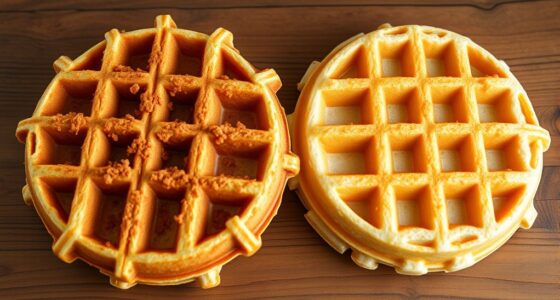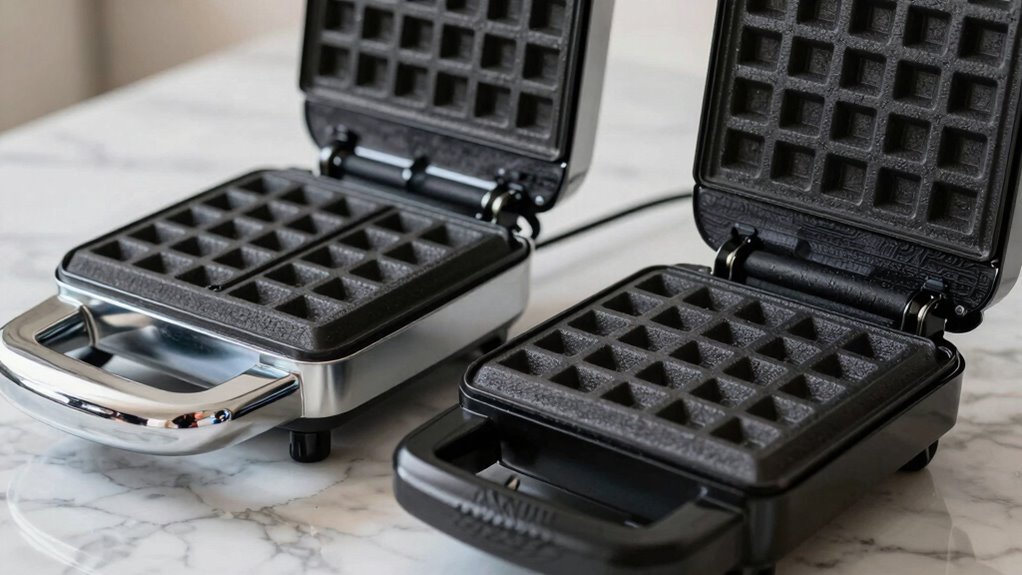

If you’re choosing between rotary and flip waffle makers, you’ll notice they distribute heat differently. Rotary models turn during cooking, promoting more even heat and batter spread, giving you crispy, golden waffles with fewer hot spots. Flip models rely on flipping to spread batter and maintain heat, which can be quicker but may result in less uniform cooking if not done carefully. To uncover more about how each method impacts your waffles, keep exploring the details below.

Get baking supplies delivered free with Prime
- Fast, free delivery on millions of items
- Prime Video, Amazon Music and more included
- Member-only deals all year
Key Takeaways
- Rotary waffle makers generally offer more consistent heat distribution due to their continuous rotation, reducing hot spots.
- Flip waffle makers rely on flipping for batter spread, which can lead to uneven heat and browning if not evenly distributed.
- Proper heat distribution in rotary models results in uniformly cooked, crispy waffles, while flip models depend on flipping technique for even cooking.
- Non-stick coatings and appliance quality significantly influence heat transfer and waffle release in both types.
- Overall, rotary designs tend to provide more even cooking, but user technique and device quality are crucial factors.

Are rotary and flip waffle makers truly different, or just variations of the same basic design? At first glance, they might seem similar, but the key differences lie in how they distribute heat and how you control the cooking process. When you look closely, you’ll see that the primary distinction is in their mechanism for spreading batter and guaranteeing even cooking. Rotary waffle makers turn during the cooking process, allowing the batter to spread naturally within the heated plates. Flip waffle makers, on the other hand, flip over to evenly distribute batter on both sides. These differences impact the heat distribution, which is vital for achieving perfectly crispy, golden waffles.
Understanding heat distribution is vital. Rotary models tend to be more consistent because the rotation helps the batter settle evenly across the non stick coatings. This results in fewer hot spots and a more uniform cook. Flip waffle makers, while often faster in cooking times, rely heavily on the flipping motion to spread the batter and maintain even heat. Your choice might depend on whether you prefer a more hands-off approach or a quick, flip-based method. Additionally, both types typically feature non stick coatings, but the quality of these coatings can vary. A durable non stick coating guarantees your waffles slide out easily without sticking or tearing, reducing cleanup time and prolonging the life of your appliance.
Power consumption is another aspect that sets these two apart. Rotary waffle makers often consume slightly more power because they need to maintain consistent rotation and heat. Flip models, being simpler in motion, might use a bit less energy, but this isn’t always assured. When choosing between them, consider how much energy you’re willing to spend, especially if you plan on making waffles frequently. Moreover, the heat distribution method directly influences how evenly your waffles are cooked, which is essential for achieving that perfect texture and color. Keep in mind that high-quality appliances with efficient non stick coatings and optimized power usage can make a big difference in your overall experience.
In the end, the main difference isn’t just in the flipping or rotating mechanism but in how each approach influences heat distribution and cooking consistency. If you want waffles that cook evenly with minimal effort, a rotary model might be your best bet. If speed and simplicity matter more, then a flip waffle maker could serve you better. Either way, paying attention to non stick coatings and power consumption helps you pick a reliable, efficient waffle maker that produces delicious results every time.
best rotary waffle maker with even heat distribution
As an affiliate, we earn on qualifying purchases.
As an affiliate, we earn on qualifying purchases.
Frequently Asked Questions
Which Waffle Maker Is Easier for Beginners to Operate?
You’ll find a flip waffle maker easier for beginners to operate because of its user-friendly operation and straightforward design. The learning curve is minimal, as you simply flip the device to cook the waffle evenly. In contrast, rotary models require more coordination and experience. With a flip waffle maker, you can quickly master the process, making it ideal if you’re new to making waffles and want a hassle-free experience.
How Do Cleaning and Maintenance Differ Between the Two Models?
Cleaning and maintenance differ mainly in cleaning procedures due to their non-stick coatings. With a rotary waffle maker, you typically wipe the plates with a damp cloth once cooled, avoiding abrasive cleaners. Flip models often have removable plates, making them easier to clean thoroughly—just wash with warm, soapy water. Always guarantee the non-stick coating stays intact to prevent sticking and prolong the appliance’s lifespan. Avoid metal utensils to protect the coating.
Are Rotary or Flip Waffle Makers More Durable Long-Term?
You’re likely to find rotary waffle makers more durable over time because of their sturdy construction quality. They often feature robust materials built to last, and many come with thorough warranty coverage that backs their longevity. Flip waffle makers, while convenient, may not be as resilient due to moving parts and lighter construction. For long-term durability, prioritize models with solid construction and reliable warranty coverage to guarantee your investment endures.
Which Type Is Better for Thick or Batter-Heavy Waffles?
You’ll find flip waffle makers better for thick or batter-heavy waffles because they give you more control over batter consistency and waffle thickness. The flipping action ensures even spreading and cooking, preventing batter from overflowing or being unevenly cooked. Rotary models can work too, but their design may make handling thick batter trickier. Ultimately, for dense or heavy batters, a flip waffle maker offers more consistent, fluffy results.
Do Either Have Safety Features Specific to Their Design?
Think of your waffle maker as a trusty spaceship; safety mechanisms are your shields. Both rotary and flip waffle makers have design-specific features like auto shut-off and cool-touch handles to prevent accidents. These features act as your onboard safety system, ensuring you stay secure while you create delicious waffles. So, whether you choose rotary or flip, rest assured their safety mechanisms are built to protect you during your breakfast journey.
Conclusion
So, now that you know how rotary and flip waffle makers distribute heat differently, which one feels like the right fit for your breakfast routine? Do you really want to settle for uneven waffles when the perfect golden-brown finish is just a flip away? Ultimately, understanding these differences helps you make smarter choices. After all, isn’t enjoying perfectly cooked waffles worth a little extra insight? Your mornings deserve nothing less than breakfast brilliance.
Halloween Picks
halloween
As an affiliate, we earn on qualifying purchases.