TL;DR
Building your own AI workstation used to save money, but today, prebuilt systems often cost less upfront due to component shortages and bulk buying. The decision now hinges on how much control, speed, and support you want versus the time and effort you’re willing to invest.
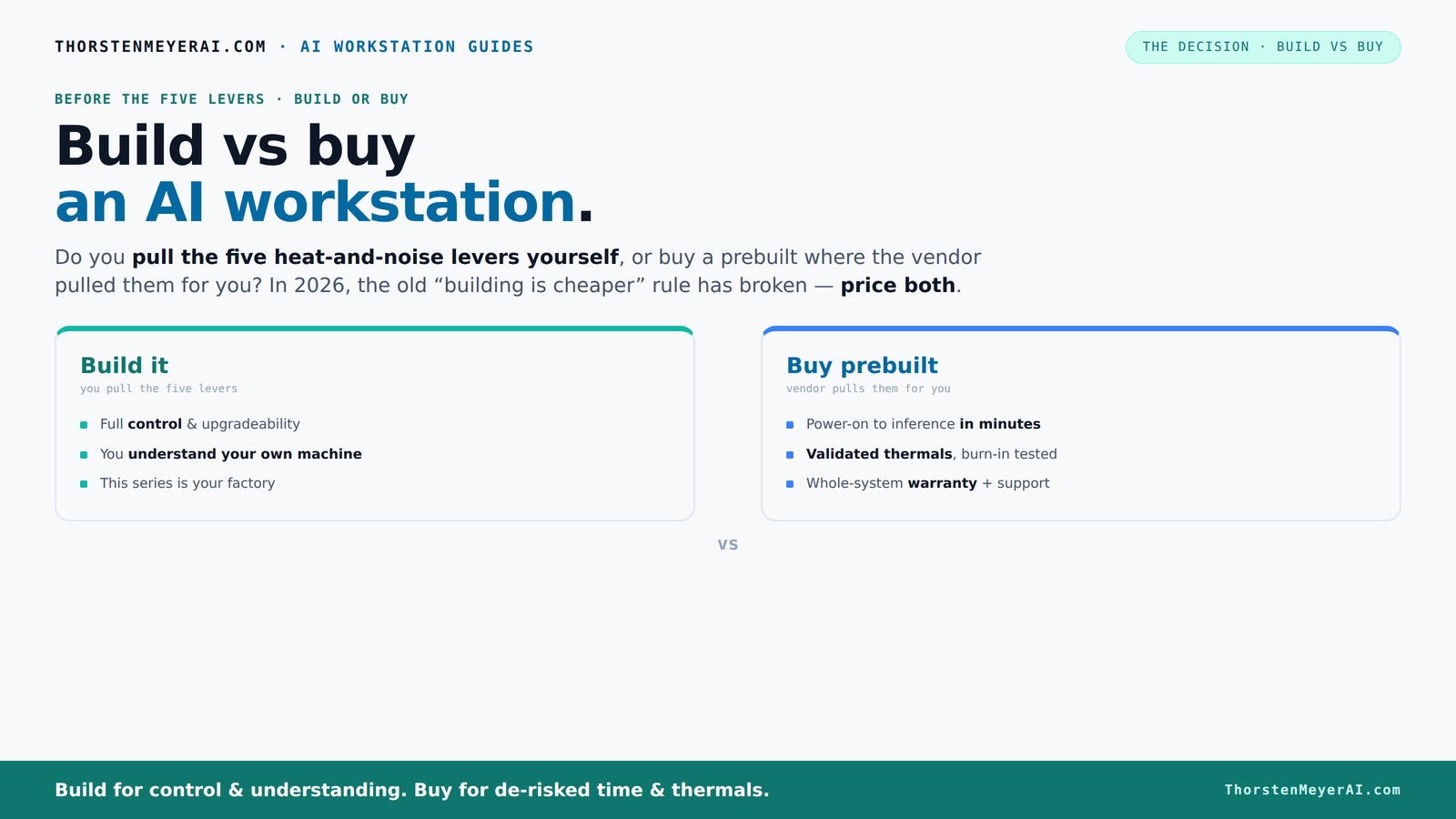
Build vs buy
an AI workstation.
The real question behind this whole series: do you pull the five heat-and-noise levers yourself, or buy a prebuilt where the vendor pulled them for you? And in 2026, the old “building is cheaper” rule has broken. Match your situation in Part 3.
Why 2026 Changes Everything About Building vs Buying
Building your own AI workstation used to be an easy way to save money, but you might want to consider building vs buying a prebuilt AI workstation now. Today, the chip shortages and inflation have flipped that script. Components like GPUs, DDR5 RAM, and SSDs have surged by 20-30%, pushing DIY prices well above prebuilt systems. For example, a DIY high-end GPU rig that once cost $2,000 now runs closer to $2,500 or more.
Meanwhile, big prebuilt vendors have secured bulk discounts before prices spiked. They’re offering systems at prices that are often hard to beat, especially when you factor in the time and effort needed to assemble, troubleshoot, and optimize a custom build. The age-old rule — 'build cheaper, buy faster' — no longer holds true without careful, real-time pricing analysis.

WIWB Gaming PC Desktop Core I9-14900HX, RTX 5060 Ti 8G, 1TB NVME SSD
- Powerful Processor: Intel Core i9-14900HX with 24 Cores
- High-Performance Graphics: GeForce RTX 5060 Ti 8GB GDDR7
- Fast Memory & Storage: 16GB DDR5 RAM with 1TB NVMe SSD
As an affiliate, we earn on qualifying purchases.
As an affiliate, we earn on qualifying purchases.
Who Pulls the Five Levers? Your Choice in Thermal and Noise Control
Making an AI workstation run cool and quiet is like tuning a high-performance engine. You have five levers: undervolting GPUs, matching cooling solutions, optimizing airflow, fine-tuning fan curves, and strategic placement.
Buy a prebuilt → the vendor handles all those levers, validating thermals and noise levels with rigorous testing. They often employ water cooling and custom fan curves, ensuring your system stays cool under sustained loads. For instance, BIZON systems promise up to 30% lower noise levels with thermal validation.
Build it yourself → you control every lever, from selecting the quiet GPU [like the RTX 4080], to choosing a case with sound-dampening panels. You can fine-tune your fans and cooling to match your environment and workload. This gives you the advantage of a finely tuned machine but requires expertise and time.
When Buying Is Faster and Less Risky
If you need your AI system up and running yesterday, prebuilt is the way to go. Systems arrive with OS and AI frameworks (like CUDA, PyTorch) already installed. Just power on, and you're ready for inference or training.
For example, a Puget Systems prebuilt can ship within a week, ready to deploy, with 24–48 hours of burn-in testing to confirm stability. Plus, vendor support covers hardware failures, reducing downtime and troubleshooting headaches.
It's perfect for teams with tight deadlines or those who prefer to avoid the hassle of sourcing parts, assembling, and tuning.
When Building Offers Precise Control and Customization
Building your own AI workstation shines when you need exact specs or specific features. Want a case with custom soundproofing? Or a GPU with the lowest noise profile? DIY lets you tailor every component and setting.
For example, you might choose a quiet CPU cooler from [here](https://thorstenmeyerai.com/quiet-cpu-coolers-ai-workstation/) or an airflow-optimized case from [this guide](https://thorstenmeyerai.com/low-noise-pc-cases-airflow/). You control everything, from the power connectors to BIOS tuning. If you're interested in the details, check out this guide on kitchen appliances and space-saving solutions for small kitchens.
But beware — this approach demands time, expertise, and patience. It’s a game for hobbyists, researchers, or companies that see their AI workstation as a strategic asset.
Cost Comparison: Building vs Buying — The Real Numbers
| Factor | Buy Prebuilt | Build Yourself |
|---|---|---|
| Initial Cost | Typically $2,500–$4,000 for high-end systems | Same or higher, depending on component choices |
| Time to Deploy | Weeks; plug in and go | Many weeks to months, including sourcing and tuning |
| Operational Support | Vendor support, warranty, quick fixes | Owner responsible for troubleshooting and upgrades |
| Customization | Limited to vendor options | Full control over every part |
| Long-term Upgrades | Limited; depends on vendor offerings | Flexible; replace or upgrade parts independently |
Performance and Longevity: Does Build Really Outperform?
In theory, building can squeeze out extra performance through tailored tuning and specific parts. For more insights, see how build vs buy a prebuilt AI workstation compares. But in practice, the performance gap shrinks because prebuilt vendors optimize their systems for high load and thermal stability. According to [2], many high-end prebuilt systems are benchmarked to run at or near peak performance under sustained load, comparable to DIY setups.
However, if your workflow demands bespoke cooling or ultra-low noise operation, building might give you a slight edge. Still, many users find that prebuilt systems last several years with minimal fuss, especially if they avoid overclocking.
Upgradeability and Future-Proofing
Building offers a clear advantage here. You choose a motherboard, RAM, and case that support future upgrades. Learn more about customizing your setup at Build vs Buy a Prebuilt AI Workstation. Want more VRAM? Just swap in a new GPU. Need faster storage? Add NVMe drives easily.
Prebuilts often come with fixed configurations, making upgrades trickier or more expensive. For example, a system with soldered RAM or proprietary power supplies limits your options.
If your AI workload is evolving or you plan to scale, building might be the smarter long-term move.
Security, Compliance, and Control: When Building Is Safer
If your AI project involves sensitive data or strict compliance, building your own system gives you full control. You decide on hardware sources, software environment, and security protocols. This reduces risks of supply chain issues or vendor lock-in.
For instance, a research lab handling proprietary models might prefer custom-built systems to keep everything fully under their watch. Prebuilt vendors may have policies or architectures that limit certain security measures.
Support, Warranty, and Peace of Mind
Prebuilt vendors often include warranties of 3–5 years and dedicated support teams. For more on support options, visit imkerhonig.org about ecological and technical topics. When something breaks, you call and get quick repairs or replacements. This can save days or weeks, especially during critical training runs.
Building your own means you’re on your own for troubleshooting hardware failures, driver issues, or thermal problems. While DIY offers flexibility, it also demands more time and technical skill.
For most teams, especially those new to high-power AI, support and warranty are worth the extra cost.
Who Should Buy, Who Should Build?
If your priority is getting up and running fast, consider a prebuilt system from airfryerhub.com for quick deployment and support. with minimal fuss, buying a prebuilt makes sense. It’s especially appealing when your workload is standard, and you want reliable support. Think: startups, research labs, or developers with tight deadlines.
On the other hand, if you’re a hobbyist, researcher, or company needing a uniquely tuned system, building your own gives you full control and potential for optimization. It’s a long-term investment that rewards technical skill and patience.
Decision Checklist: Build or Buy?
- Do you need deployment fast? → Buy
- Do you require exact hardware specs? → Build
- Is operational support crucial? → Buy
- Are you comfortable troubleshooting hardware? → Build
- Planning to upgrade or scale? → Build
- Want a ready-to-go system with minimal setup? → Buy
Key Takeaways
- The 2026 chip shortages have made prebuilt AI workstations often cheaper or equal in price to DIY builds.
- Buy a prebuilt if you need quick deployment, validated thermals, and support.
- Build if you want full control, custom tuning, and future upgrade paths.
- Both options now require careful cost analysis based on current market prices.
- Hybrid solutions — buy the core, customize the rest — are increasingly popular for balancing speed and control.