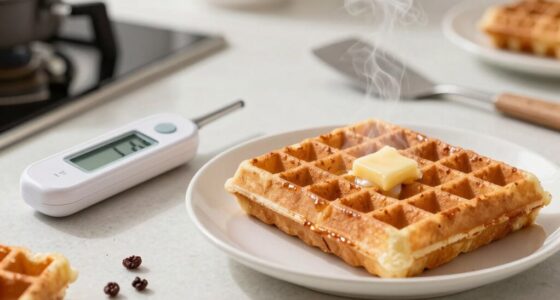
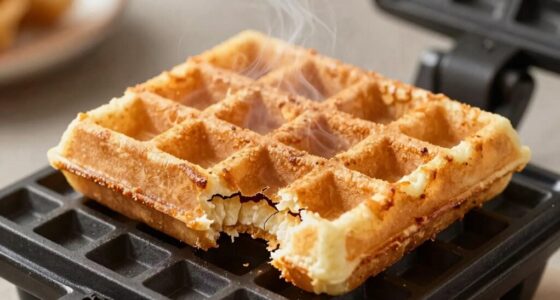
When your waffles brown too fast, the first thing to fix is the temperature setting on your waffle maker. Lowering the heat allows for a slower, more even browning process and helps prevent burning outside while ensuring the inside cooks properly. Make sure the waffle maker is fully preheated before pouring batter, and give it a few seconds after adjusting the temperature. Keep in mind that fine-tuning your technique can lead to perfect waffles—get the details right, and you’ll see the difference.

Get baking supplies delivered free with Prime
- Fast, free delivery on millions of items
- Prime Video, Amazon Music and more included
- Member-only deals all year
Key Takeaways
- Lower the waffle maker temperature setting to slow browning.
- Ensure the waffle maker is fully preheated before pouring batter.
- Check for uneven or residue build-up on the cooking surface.
- Use a batter with the proper consistency—thick enough to prevent rapid browning.
- Allow the waffle maker to stabilize temperature after adjustments before cooking.

Have your waffles brown too quickly on the outside before they’re fully cooked inside? If so, your first step is to look at how you’re preparing your batter and how you’re managing your waffle maker’s temperature. When the batter is too thick or too thin, it can affect how evenly the heat cooks your waffles. Adjusting batter consistency is key; a batter that’s too thick may cause the outside to crisp up before the inside cooks through, while a thin batter can lead to overly rapid browning. Aim for a smooth, pourable consistency—somewhere between pancake batter and thick cream. If your batter is too stiff, add a splash of milk or water to loosen it up. Conversely, if it’s too runny, add a little more flour or cornstarch to thicken it. Achieving the right batter consistency helps ensure heat distributes evenly during cooking. Proper batter consistency is essential for even cooking and browning. Additionally, using a consistent stirring technique can help prevent uneven distribution of ingredients, which might affect browning. You can also consider measuring ingredients carefully to maintain uniformity in each batch. It’s also beneficial to let the batter rest for a few minutes before pouring; this can allow the flour to hydrate fully, leading to better browning control.
Controlling waffle maker temperature is equally important. Many waffle irons come with adjustable settings, but if yours doesn’t, or if it’s malfunctioning, it’s time to check and regulate the heat. A high temperature can cause the exterior to brown rapidly, leaving the inside undercooked. Lower the heat setting slightly and give the waffle maker a few moments to reach a more moderate temperature. If your waffle maker has a temperature dial, experiment with reducing it until you get a more gradual, even browning. It’s also helpful to let your waffle maker preheat fully before pouring in batter. This ensures the heat is steady and reduces the risk of uneven cooking. Proper waffle maker preheating can help prevent hot spots that cause uneven browning. Moreover, inspecting the cooking surface for any unevenness or residue can further contribute to consistent browning. Clean the plates thoroughly, and if needed, apply a light coat of non-stick spray to promote even heat transfer. Remember, patience is vital here. After adjusting the batter and temperature, wait a few extra seconds before opening the lid. Rushing the process can lead to undercooked centers or burnt exteriors. Ensuring the heat distribution is uniform across the surface is also crucial for achieving evenly browned waffles. Also, periodically checking the temperature stability of your waffle maker can help maintain consistent browning over multiple batches.
adjustable waffle maker temperature control
As an affiliate, we earn on qualifying purchases.
As an affiliate, we earn on qualifying purchases.
Frequently Asked Questions
Can Adjusting the Waffle Iron Temperature Prevent Quick Browning?
Yes, adjusting the waffle iron temperature can prevent quick browning by controlling the waffle color. Lowering the temperature allows the batter to cook more evenly and slowly, reducing the risk of burning or overly dark waffles. Make sure your waffle iron has good temperature control. By finding the right setting, you’ll get waffles with a perfect golden color without rushing or burning.
Does Batter Consistency Affect How Quickly Waffles Brown?
Ironically, your batter’s consistency can speed up how quickly waffles brown. Thinner batter spreads more evenly and crisps faster, making your waffles seem like they’re in a rush. To slow things down, focus on proper mixing techniques and guarantee ingredients are at the right temperature—cold milk or eggs help control browning. When batter is too runny, it’s a quick ticket to over-browning, so aim for a thicker, smoother mix.
How Does Humidity Influence Waffle Browning Speed?
Humidity effects play a significant role in how quickly your waffles brown. Higher moisture impact from humidity keeps the batter wetter, which slows browning because the moisture needs to evaporate before the Maillard reaction occurs. Conversely, low humidity allows faster browning as moisture evaporates more quickly. To manage this, adjust your batter or cooking time based on the humidity level, ensuring your waffles brown evenly without burning.
Are There Specific Waffle Iron Brands That Brown Faster?
Some waffle iron brands tend to brown waffles faster due to design and heating elements. Brands like Cuisinart and Breville often heat evenly, but you might find others that produce quicker browning. To control this, focus on proper waffle iron maintenance—cleaning and adjusting temperature settings. Experiment with waffle recipe variations, such as reducing sugar or fat, to slow browning. Always monitor your waffle iron to achieve the perfect crispness without over-browning.
Can Using Different Types of Flour Change Browning Rate?
Ever wonder if your choice of flour impacts how quickly your waffles brown? Yes, switching flours can change the browning rate because different types affect gluten development and flavor enhancement. For instance, using whole wheat flour may cause faster browning due to higher natural sugars, while almond flour browns slower. Experimenting with various flours lets you control browning and enhance flavor, making each waffle uniquely delicious.
Conclusion
If your waffles brown too quickly, start by adjusting the heat setting on your waffle iron—they’re often too high. Did you know that reducing the heat by just 25°F can substantially slow browning and improve texture? By fixing this first, you’ll get perfectly golden waffles every time. Remember, a slight tweak can make a big difference, so don’t hesitate to experiment until you find the ideal temperature for your waffle iron.
Columbus Day / Indigenous Peoples' Day Picks
long weekend sales
As an affiliate, we earn on qualifying purchases.