

TL;DR

Get baking supplies delivered free with Prime
- Fast, free delivery on millions of items
- Prime Video, Amazon Music and more included
- Member-only deals all year
This article explains how you can process videos entirely on your device, creating everything from titles to social posts without uploading to the cloud. It’s faster, more private, and cuts costs—perfect for creators and security teams alike.
Imagine turning one video into a dozen different publishing assets—titles, descriptions, clips, social posts—without ever sending a file to the cloud. It sounds like magic, but it’s becoming reality with local AI tools that process everything right on your machine.
This approach means more privacy, no monthly subscriptions, and faster turnaround times. If you’re tired of waiting for cloud services to generate your content, stick around. I’ll show you how a single video can fuel your entire publishing pipeline—completely offline, entirely on-site.
Key Takeaways
- Processing videos locally keeps all data on your device, boosting privacy and control.
- A single uploaded video can generate titles, clips, descriptions, and social posts—all offline.
- Hardware limits are around 1,000 detections per hour, suitable for small to medium setups.
- No subscription fees means long-term savings over cloud AI services.
- Setup is straightforward: connect your camera or upload, analyze, review, and publish.
local AI video processing hardware
As an affiliate, we earn on qualifying purchases.
As an affiliate, we earn on qualifying purchases.
What does ‘without the cloud’ really mean for your video workflow?
‘Without the cloud’ means all processing, storage, and metadata generation happen directly on your local device—no data leaves your machine. This drastically reduces privacy concerns and dependency on internet speeds or third-party servers.
For example, a security team using a local AI key can analyze footage from multiple cameras, generate searchable descriptions, and create clips—all without uploading sensitive footage to external servers. That’s a game-changer for privacy-conscious users.

How does local AI process videos faster and safer than cloud services?
Local AI processes videos directly on your hardware, which means faster turnaround and tighter control. Instead of waiting minutes or hours for cloud servers to analyze footage, your device does it instantly—often in real time.
Take a mid-sized security operation: with a local AI key, they can analyze 500 detections per hour without cloud lag or data leaks. Plus, all data stays on-site, reducing legal risks and protecting sensitive footage.

What assets can a local AI workflow generate from one video?
From a single video, a local AI system can produce:
- Searchable transcripts and captions
- Titles and descriptions optimized for platforms
- Short clips for TikTok, Reels, Shorts
- Thumbnails based on key moments
- Blog drafts and newsletter snippets
- Social media posts tailored to each network
For instance, a YouTuber can upload a weekly vlog, and within minutes, have clips ready for Instagram, Twitter, and Facebook, all generated locally without cloud fees.

Comparison: Cloud-based vs. Local Video AI — Which fits your needs?
| Feature | Cloud AI | Local AI |
|---|---|---|
| Data Privacy | Data leaves your device | All processing stays on-site |
| Cost | Subscription fees apply | One hardware purchase, no recurring costs |
| Speed | Dependent on internet and server load | Immediate processing, real-time results |
| Customization | Limited control over model updates | Full control, customizable prompts and models |
| Scalability | High, with cloud resources | Limited by hardware capacity (~1000 detections/hr) |
Step-by-step: Setting up your local video publishing kit
- Choose your hardware: a dedicated AI key or high-performance PC with enough storage and processing power.
- Install the software—check out [ChannelHelm](https://channelhelm.com/) for a local-first video pipeline.
- Connect your cameras or upload your videos to the system.
- Configure your detection settings—select what you want to identify or extract.
- Run the analysis—watch your assets generate in real-time or batch mode.
- Review and edit assets in your dashboard, then dispatch to your platforms.
Why privacy-minded creators and security teams love this approach
Processing everything locally keeps your footage private, reduces cloud costs, and avoids data breaches. For example, a security firm analyzing confidential surveillance footage can generate searchable logs without risking leaks or legal issues.
Plus, creators get immediate feedback—titles, clips, and social posts—without waiting for cloud processing. It’s a faster, safer way to manage content, especially when dealing with sensitive or proprietary footage.

What are the limits of local AI? When does it matter?
While powerful, local AI has capacity limits—around 1,000 detections per hour per device. This cap is essential to understand because it influences how much data you can process efficiently in real time. For example, in environments with high motion or frequent events, hitting this ceiling could mean delays or missed detections.
Understanding these limits helps you plan your infrastructure—whether by scaling with additional devices or integrating hybrid solutions that offload some processing to the cloud during peak times. These tradeoffs between speed, privacy, and capacity are critical for tailoring your setup to your specific needs. Recognizing the capacity limits also helps you avoid overloading your hardware, which could lead to system slowdowns or inaccuracies. By proactively planning for these constraints, you ensure your workflow remains smooth and reliable, balancing performance with privacy.

How to turn a single video into a full publishing kit today
Here’s a quick rundown:
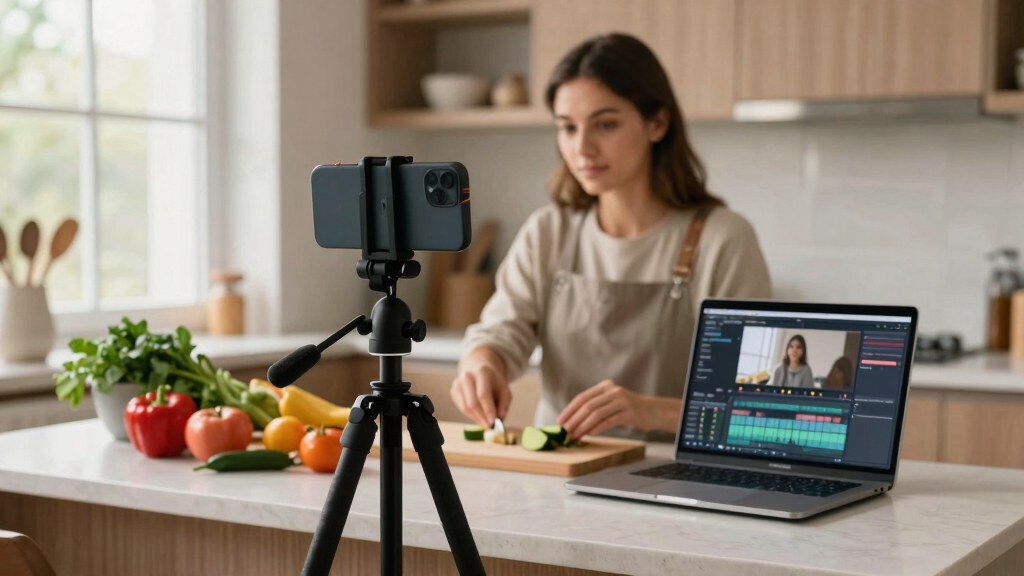
- Drop your video into a local AI platform like ChannelHelm.
- Let it analyze audio, visuals, and extract key moments.
- Review the automatically generated assets—titles, clips, metadata.
- Edit or regenerate anything that needs tweaking.
- Dispatch your assets directly to YouTube, TikTok, blogs, or social media—all from your machine.
The future of local, cloud-free video publishing
Expect more tools that process videos entirely on-site, giving creators and security teams full control. As hardware gets faster and smarter, your workflow will become faster, safer, and more private.
This shift aligns with the growing demand for privacy and cost savings. Soon, you’ll be able to generate complete publishing kits from a single upload—without ever touching the cloud.
Frequently Asked Questions
Does local AI processing mean no data is ever sent off-site?
Yes. When using a local AI system like ChannelHelm, all processing happens on your device. Your footage and metadata stay private, with no need to upload anything to the cloud.
Absolutely. A local AI workflow can produce transcripts, titles, clips, thumbnails, and even social media posts tailored for each platform, all from a single upload. This capability streamlines content creation, enabling faster publishing cycles and reducing reliance on external services. However, be aware that the quality of outputs depends on your setup and calibration, and complex or high-volume projects might require additional hardware or hybrid approaches for optimal performance. Additionally, understanding the tradeoffs between speed and accuracy is crucial; while local AI is fast, it may sometimes need manual review to ensure content quality, especially for high-stakes or highly polished productions.
What’s the hardware requirement for running this kind of AI processing?
You’ll need a device with a decent GPU or dedicated AI key—like those compatible with G4, G5, or AI series cameras—and enough storage. Most small to medium setups handle around 1,000 detections per hour comfortably. Keep in mind that higher detection volumes or real-time processing demands might necessitate more powerful hardware or multiple units to maintain efficiency. Choosing the right hardware involves balancing cost, performance, and future scalability—investing in a robust system can reduce bottlenecks as your content needs grow.
Is there a monthly fee or subscription for this local AI workflow?
No. One of the biggest advantages is that it’s a one-time hardware investment—no recurring cloud fees or subscriptions. This makes it especially attractive for creators or organizations aiming to reduce ongoing costs while maintaining full control over their content pipeline. Keep in mind, however, that software licenses or updates might have associated costs, but these are generally minimal compared to cloud subscription fees.
How accurate are the AI-generated descriptions and tags?
While highly effective, accuracy depends on your setup and calibration. Expect 80–90% accuracy in identifying key moments and generating relevant metadata, making it a powerful tool for quick content creation. Regular calibration and updates can further improve these results, but it’s important to understand the limitations and verify outputs for critical applications. Recognizing these tradeoffs helps you decide when manual review is necessary and when to rely on automation, ensuring your content quality remains high while benefiting from the efficiency of local AI processing.
Conclusion
Turning one video into a full publishing kit without the cloud isn’t just a tech dream. It’s a practical reality that puts you in the driver’s seat—saving time, protecting privacy, and slashing costs.
Imagine a future where every piece of content you create is fully controlled on your machine—no dependency, no waiting. That future is here. Are you ready to make your workflow smarter and safer?

Halloween Picks
halloween
As an affiliate, we earn on qualifying purchases.